

Carbon Fiber Automotive Checking Fixture for Exterior Inspection
Precision inspection of automotive exterior components requires checking fixtures that can accurately reproduce vehicle assembly conditions while remaining practical for frequent use on the production floor. TTM GROUP develops lightweight and high-precision carbon fiber automotive checking fixture solutions for applications such as fender openings, bumper openings, body matching areas, and other critical exterior interfaces.
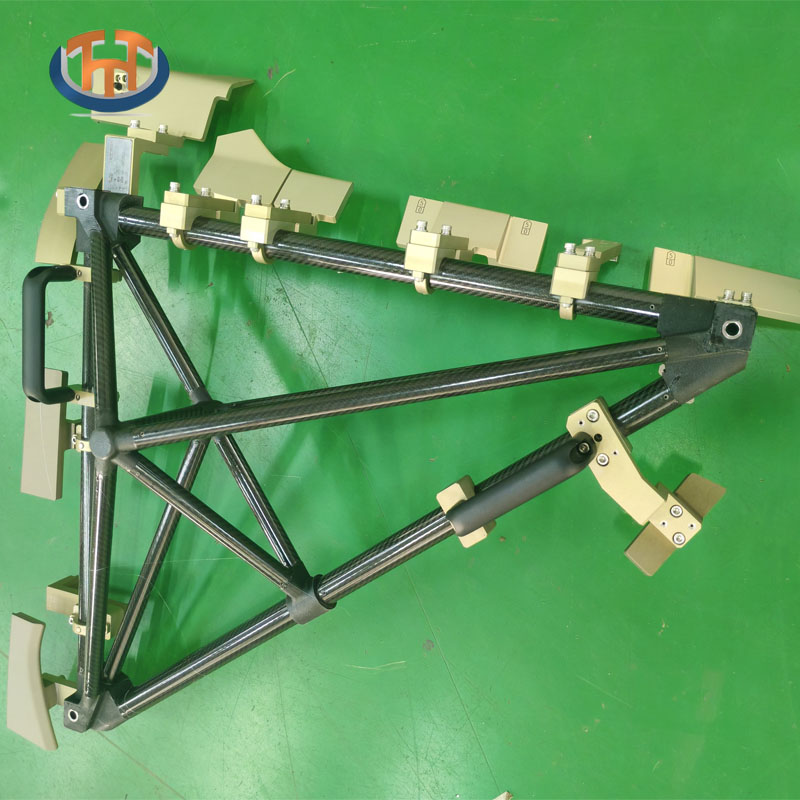
These checking fixtures are designed to simulate the actual matching relationships between automotive body components, allowing manufacturers to verify dimensional accuracy, exterior gaps, flushness, and component positioning during development and production.
By combining carbon fiber structures with precision-machined aluminum inspection surfaces, TTM GROUP provides lightweight inspection solutions that balance portability, rigidity, wear resistance, and dimensional stability.
Fender Opening Checking Fixture
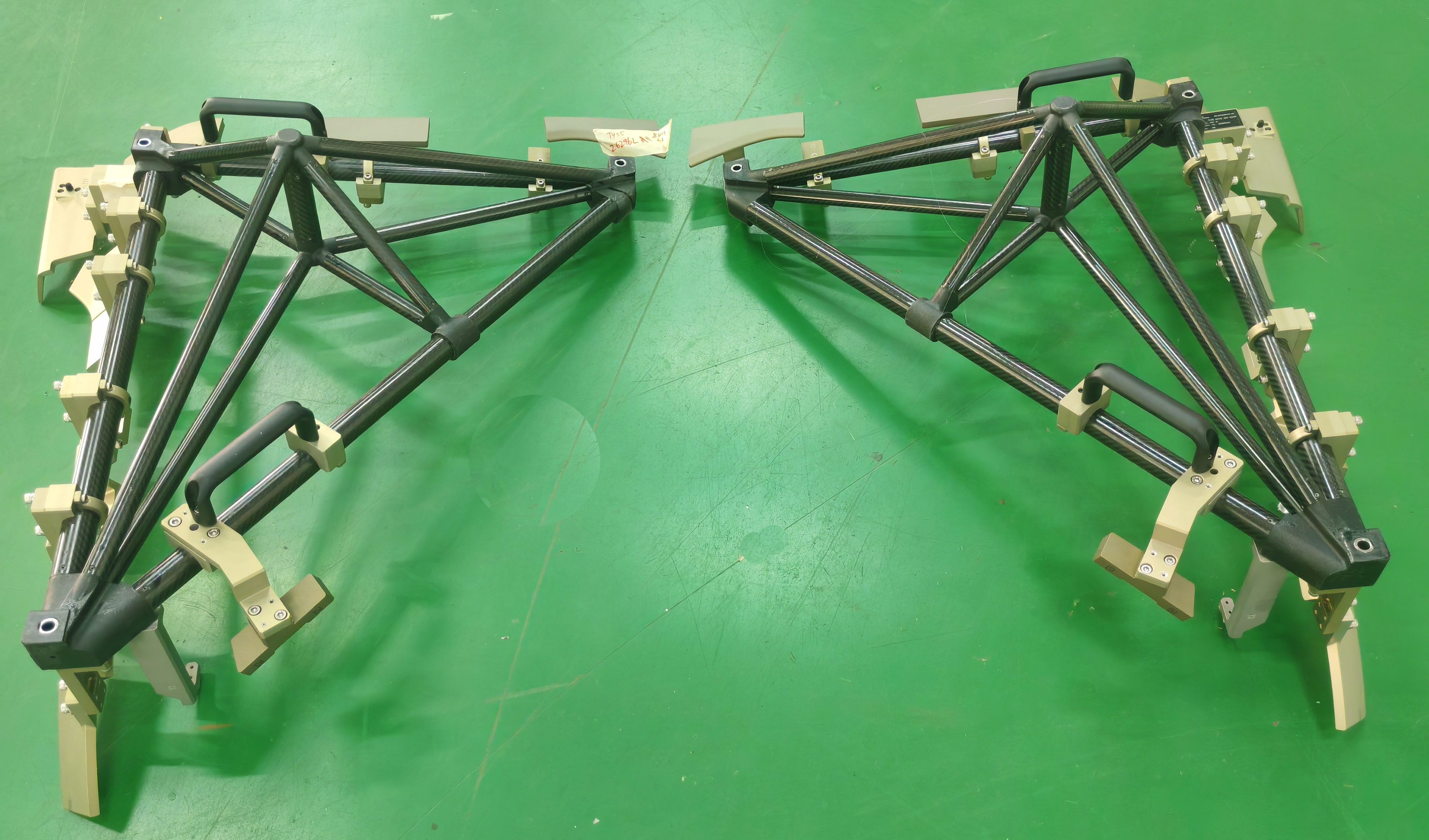
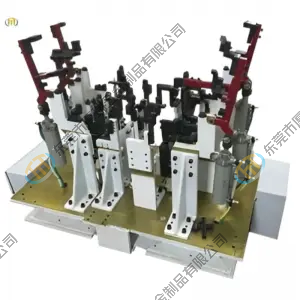
The first fixture is designed specifically for fender opening inspection.
The fixture accurately simulates the matching areas between the fender, hood, front body section, and A-pillar. These interfaces are particularly important for vehicle exterior quality because even small dimensional deviations can affect visible gaps and flushness after assembly.
During inspection, the fixture provides defined reference and checking surfaces that reproduce the required vehicle matching conditions. This allows operators and quality engineers to evaluate whether the exterior component meets the specified dimensional requirements.
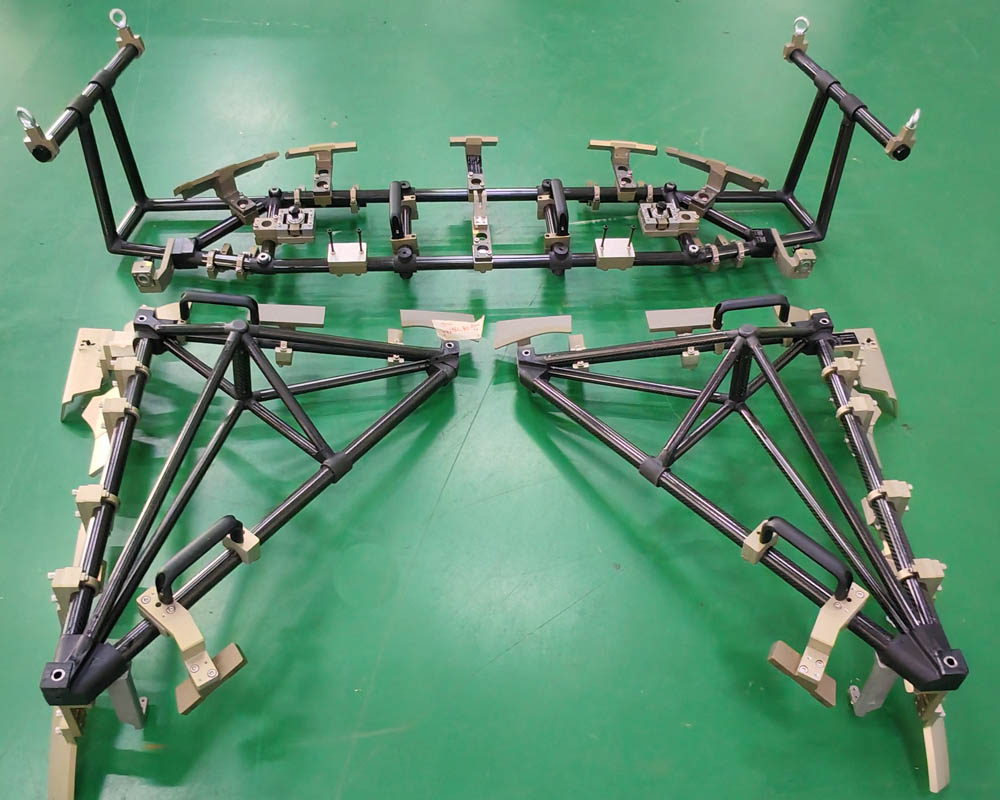
The fixture can be used for checking areas such as:
- Fender opening dimensions
- Fender-to-hood gaps
- Fender-to-body matching
- A-pillar interface areas
- Exterior flushness
- Component positioning
- Local dimensional deviations
The overall structure is manufactured using lightweight carbon fiber, resulting in a fixture weight of approximately 7 kilograms.
This lightweight construction is particularly beneficial in production environments where operators need to move or reposition inspection fixtures repeatedly throughout the working day.
Lightweight Carbon Fiber Structure
One of the key features of this carbon fiber automotive checking fixture is its lightweight construction.
Traditional inspection fixtures can become relatively heavy when large metal structures are required. Carbon fiber provides an alternative structural material that offers a favorable combination of low weight and structural rigidity.
For production-line inspection, reducing fixture weight can provide several practical advantages.
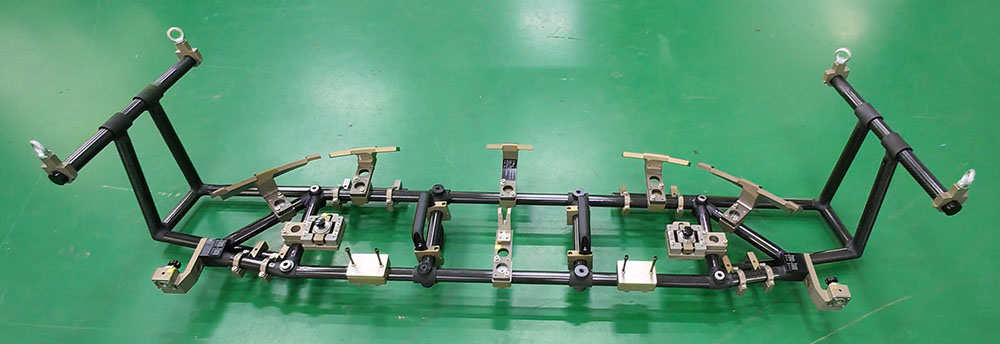
A lightweight fixture can be:
- Easier for operators to handle
- Faster to position on the component
- More convenient for repeated inspections
- Easier to transport between inspection areas
- Less demanding during manual operation
The approximately 7 kg fender opening fixture demonstrates how carbon fiber can be applied to automotive inspection tooling without compromising the precision required for dimensional verification.
Hard-Anodized Aluminum Inspection Surfaces
While carbon fiber is used for the main structural frame, the inspection surfaces are manufactured from aluminum and treated with a hard-anodizing process.
The hard-anodized aluminum surfaces provide improved wear resistance for repeated contact during inspection operations.
This is particularly important for production environments where fixtures may be used hundreds or thousands of times over their service life.
The inspection surfaces need to maintain their dimensional characteristics while resisting surface wear caused by repeated operation.
The combination of a carbon fiber structural frame and hard-anodized aluminum inspection surfaces therefore creates a practical balance between:
Low Weight + Structural Rigidity + Wear Resistance + Dimensional Stability
Front Bumper Opening Checking Fixture
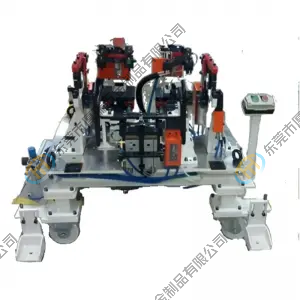
The second fixture is designed for front bumper opening inspection.
Its primary inspection area focuses on the matching relationship between the front bumper and hood.
The fixture provides a defined reference structure for evaluating the dimensional relationship between these exterior components. This can help manufacturers identify deviations that could result in inconsistent gaps, uneven flushness, or incorrect component positioning.
Front bumper areas can contain complex curved surfaces and multiple interfaces with surrounding body components. An appropriate automotive checking fixture helps translate these three-dimensional relationships into repeatable inspection conditions.
The second fixture weighs approximately 13 kilograms and uses a high-strength carbon fiber structure.
Integrated Lifting Assistance
Because the second fixture is larger and heavier than the fender opening fixture, it is equipped with a dedicated lifting assistance mechanism.
This feature is designed to make fixture handling easier in production environments.
Instead of requiring operators to manually manage the full weight of the fixture during every inspection operation, the lifting assistance mechanism helps improve handling efficiency and ergonomics.
This is particularly useful for production lines where inspection operations are repeated frequently.
The design demonstrates an important principle in modern lightweight checking fixture development: reducing weight is valuable, but handling ergonomics should also be considered as part of the complete fixture design.
Designed for Automotive Exterior Inspection
Automotive exterior components require strict dimensional control because their appearance is directly affected by the relationship between adjacent panels.
Small dimensional deviations can influence:
- Panel gaps
- Flushness
- Surface alignment
- Assembly positioning
- Visual quality
- Final vehicle appearance
A properly designed carbon fiber checking fixture provides stable references for evaluating these relationships.
For fender, bumper, hood, and body opening applications, the fixture can help quality teams identify dimensional deviations earlier in the manufacturing process.
This supports more consistent inspection and reduces the risk of dimensional problems reaching final vehicle assembly.
Precision and Portability in One Fixture
A major advantage of these TTM GROUP fixtures is the combination of precision inspection capability and lightweight construction.
A checking fixture must remain sufficiently rigid and dimensionally stable during inspection. At the same time, production-line fixtures need to be practical for operators to handle.
Carbon fiber provides an effective structural solution for this type of application.
The first fixture weighs only about 7 kg, while the second weighs approximately 13 kg and incorporates lifting assistance. These design choices demonstrate how fixture engineering can be adapted to the practical requirements of production environments.
Rather than focusing only on dimensional accuracy, TTM GROUP considers the complete inspection workflow, including fixture positioning, operator handling, durability, and repeated production use.
Applications of Carbon Fiber Automotive Checking Fixture
TTM GROUP’s carbon fiber automotive checking fixture technology can be adapted to various automotive exterior inspection applications.
Typical applications include:
- Fender opening inspection
- Front bumper opening inspection
- Hood matching inspection
- Door opening inspection
- Body-side panel inspection
- Exterior gap inspection
- Flushness inspection
- Component positioning verification
- Body-in-white dimensional inspection
- Assembly quality verification
The specific inspection surfaces and reference points can be developed according to vehicle 3D data and the customer’s inspection requirements.
TTM GROUP Automotive Checking Fixture Solutions
TTM GROUP provides engineering and manufacturing capabilities for automotive checking fixtures, inspection tooling, welding fixtures, stamping dies, CNC machining, and automated manufacturing solutions.
For complex automotive components, fixture development can begin with the customer’s 3D data and inspection requirements. Engineers then determine the appropriate reference points, inspection surfaces, structural configuration, materials, and handling method.
For applications where fixture weight is an important consideration, carbon fiber can be incorporated into the structural design.
For inspection surfaces requiring repeated contact and wear resistance, precision-machined and surface-treated aluminum can be used.
This combination allows TTM GROUP to develop inspection fixtures that are not only accurate but also practical for real production environments.
A Practical Solution for Production-Line Inspection
The two fixtures presented here demonstrate different approaches to lightweight automotive inspection.
The approximately 7 kg fender opening fixture emphasizes portability and easy manual handling. Its carbon fiber frame and hard-anodized aluminum inspection surfaces provide a combination of lightweight construction and durable inspection capability.
The approximately 13 kg front bumper opening fixture uses a high-strength carbon fiber structure and incorporates a lifting assistance mechanism to improve handling efficiency.
Both designs are developed around the same objective: providing reliable dimensional inspection while making the fixture practical for repeated production use.
For automotive manufacturers and Tier 1 suppliers, this combination can help improve inspection efficiency while maintaining the dimensional control required for exterior components.
Conclusion
A modern carbon fiber automotive checking fixture should do more than provide dimensional references. It should combine precision, structural stability, durability, portability, and operator-friendly handling.
TTM GROUP’s fender opening and front bumper opening checking fixtures demonstrate how carbon fiber structures and hard-anodized aluminum inspection surfaces can be combined to create lightweight and durable inspection tooling.
With approximately 7 kg and 13 kg fixture weights, together with dedicated handling features, these solutions are designed for practical use in automotive production environments.
By integrating fixture engineering, precision manufacturing, material selection, and inspection requirements, TTM GROUP continues to provide advanced automotive checking fixture solutions for exterior components and complex vehicle assemblies.

.png)
.png)