
Smart Checking Fixture Development Trends in Automotive Manufacturing
Smart Checking Fixture: The Future of Intelligent Automotive Quality Control
With the rapid development of Industry 4.0, electric vehicles, and intelligent manufacturing technologies, the automotive industry is entering a new era of digital quality management. Traditional inspection methods are gradually being replaced by advanced Smart Checking Fixtures that combine automation, digital measurement, and intelligent data analysis.
A modern Automotive Checking Fixture is no longer just a tooling device used for dimensional verification. It has become an important part of the automotive manufacturing process, helping manufacturers improve product accuracy, reduce inspection time, and achieve real-time quality control.
As a professional Checking Fixture Manufacturer, companies need to provide not only high-precision fixtures but also complete Automotive Quality Control Solutions that support smart factories and global automotive production requirements.
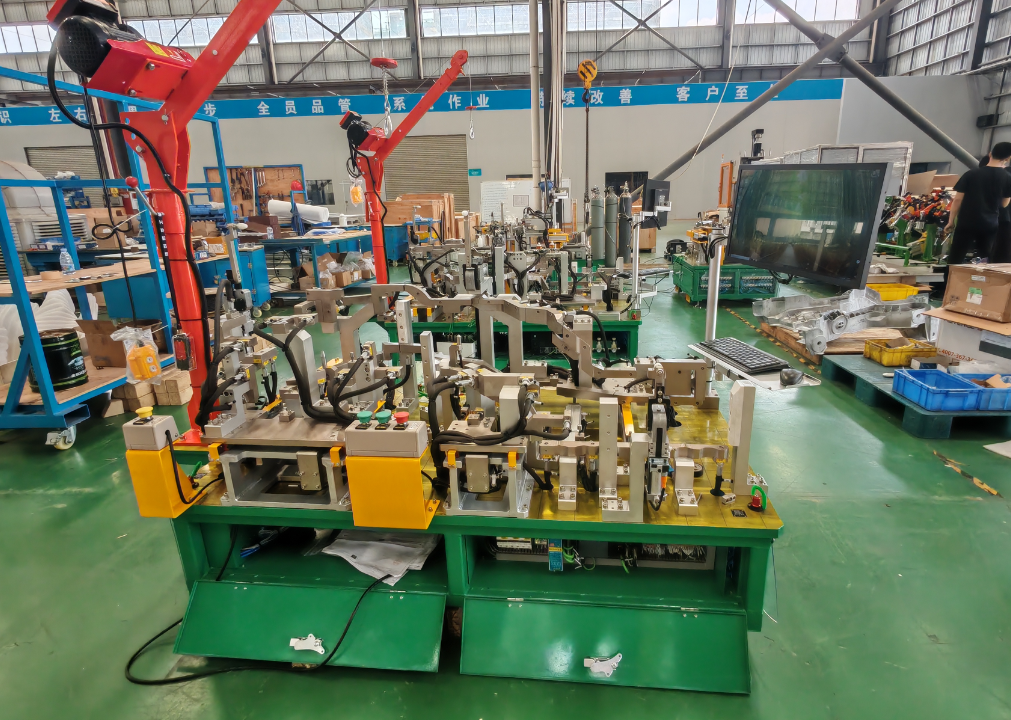
1. From Traditional Checking Fixtures to Smart Checking Fixtures
Traditional checking fixtures have been widely used in automotive manufacturing for decades. They are mainly operated manually by technicians using gauges, measuring tools, and visual inspection methods.
However, traditional inspection processes have several limitations:
- Low inspection efficiency
- High dependence on operator experience
- Difficult quality data management
- Limited traceability of inspection results
With the introduction of Intelligent Checking Fixtures, inspection processes are becoming more automated and data-driven.
By integrating advanced technologies such as:
- Sensors
- Laser measurement systems
- Industrial cameras
- RFID tracking
- Digital data collection systems
smart fixtures can automatically measure parts, record inspection results, and provide instant feedback.
The future Automotive Inspection Fixture will not only identify whether a part meets quality requirements but also analyze potential problems before they affect production.
2. Digitalization Becomes a Major Trend in Automotive Inspection
Digital transformation is one of the most important trends in modern manufacturing.
Future Smart Checking Fixtures will be connected with:
- MES production management systems
- QMS quality management platforms
- ERP systems
- Industrial IoT networks
This connection allows manufacturers to create a complete digital quality control process:
Production → Inspection → Data Collection → Analysis → Process Optimization
For example, during automotive stamping production:
The stamping part is produced
↓
The robot transfers the part to the checking fixture
↓
The fixture automatically measures key dimensions
↓
Inspection data is uploaded to the system
↓
Quality results are generated automatically
This closed-loop inspection process helps automotive suppliers improve production stability and reduce quality risks.
3. AI Vision Technology Improves Inspection Accuracy
One of the biggest developments in smart inspection technology is the combination of artificial intelligence and machine vision.
AI-based inspection systems can significantly improve the capability of Automotive Checking Fixtures.
Surface Defect Inspection
AI vision technology can detect:
- Scratches
- Dents
- Surface defects
- Welding quality issues
- Appearance problems
This reduces dependence on manual visual inspection.
Assembly Verification
Smart inspection systems can check:
- Missing components
- Incorrect assembly positions
- Fastener installation
- Component matching
This is especially important for complex automotive assemblies.
Automatic Dimensional Inspection
By combining:
- 3D scanning technology
- Laser measurement
- Vision measurement systems
smart fixtures can quickly capture accurate dimensional information and generate inspection reports.
4. Multi-Functional Integration of Smart Checking Fixtures
The future development direction of checking fixtures is moving from single-function tools toward integrated quality control platforms.
Traditional fixtures mainly focus on:
- Hole position checking
- Gap and flush measurement
- Dimensional verification
However, modern Intelligent Checking Fixtures can integrate multiple functions:
- Dimensional inspection
- Visual inspection
- Assembly confirmation
- Data recording
- Quality analysis
This allows one fixture system to complete multiple inspection tasks and improve production efficiency.
5. Integration with Robotics and Automation Systems
With the development of smart factories, checking fixtures are increasingly combined with automation technologies.
A complete intelligent inspection workstation may include:
- Industrial robots
- Automatic loading systems
- AGV transportation
- Automated measurement equipment
The inspection process can be completed automatically:
Robot loading
↓
Automatic positioning
↓
Fixture clamping
↓
Inspection measurement
↓
Data analysis
↓
Quality classification
For suppliers providing Welding Fixture and Automation System solutions, integrating smart inspection technology creates greater value for automotive customers.
6. Lightweight and Modular Design of Automotive Checking Fixtures
The growth of electric vehicles has created new challenges for inspection tooling.
Modern automotive components such as:
- Battery trays
- Aluminum body parts
- Large structural components
require higher accuracy and more flexible inspection solutions.
Future Automotive Inspection Fixtures will increasingly adopt:
- Lightweight aluminum structures
- Modular fixture designs
- Flexible positioning systems
- Advanced manufacturing technologies
The benefits include:
- Reduced fixture weight
- Faster development time
- Easier modification
- Lower manufacturing costs
7. Digital Twin Technology in Smart Quality Management
Digital twin technology will become an important part of future smart inspection systems.
A digital twin creates a connection between the physical checking fixture and its virtual model.
Engineers can monitor:
- Fixture status
- Measurement results
- Dimensional changes
- Quality trends
in real time.
Through data analysis, manufacturers can predict potential quality issues and optimize production processes before problems occur.
8. New Energy Vehicles Accelerate the Demand for Smart Checking Fixtures
The rapid development of electric vehicles is creating increasing demand for advanced inspection solutions.
New energy vehicle manufacturing requires strict quality control for:
Battery Components
Including:
- Battery housings
- Battery trays
- Structural parts
These components require high precision and excellent consistency.
Large Automotive Structural Parts
New manufacturing technologies such as integrated casting require advanced inspection equipment to ensure dimensional accuracy.
Intelligent Vehicle Components
Sensors, cameras, and electronic components require precise positioning and reliable inspection methods.
These trends are driving automotive manufacturers to adopt more advanced Smart Checking Fixture Solutions.
Future Outlook of Smart Checking Fixtures from 2025 to 2030
The development path of smart checking fixtures can be summarized as:
High Precision → Digitalization → Automation → Networking → Artificial Intelligence
In the future, checking fixtures will evolve from traditional inspection tools into complete Intelligent Quality Control Systems.
Automotive manufacturers will increasingly look for suppliers that can provide:
- Automotive Checking Fixtures
- Automotive Inspection Fixtures
- Welding Fixtures
- Automation Systems
- Digital Quality Management Solutions
Conclusion: Smart Checking Fixtures Drive the Future of Automotive Manufacturing
Smart Checking Fixtures are becoming a key technology for improving automotive manufacturing quality and production efficiency.
For a professional Checking Fixture Manufacturer, future competitiveness will depend not only on fixture design and machining capabilities but also on digital technology, automation integration, and intelligent inspection solutions.
By combining Automotive Checking Fixtures, Welding Fixture and Automation Systems, and advanced digital quality control technologies, suppliers can help global automotive customers achieve higher accuracy, faster production, and smarter manufacturing.
Post time: Jul-20-2026

.png)
.png)