
In high-volume automotive manufacturing, tooling stability has a direct impact on production efficiency, dimensional accuracy, and overall manufacturing costs. A well-engineered Progressive Die Design allows multiple stamping operations to be completed continuously as the metal strip moves through different stations.
However, simply combining several operations into one stamping tool does not guarantee stable production. Engineers must carefully consider material flow, feeding accuracy, die rigidity, forming forces, component wear, and maintenance requirements.
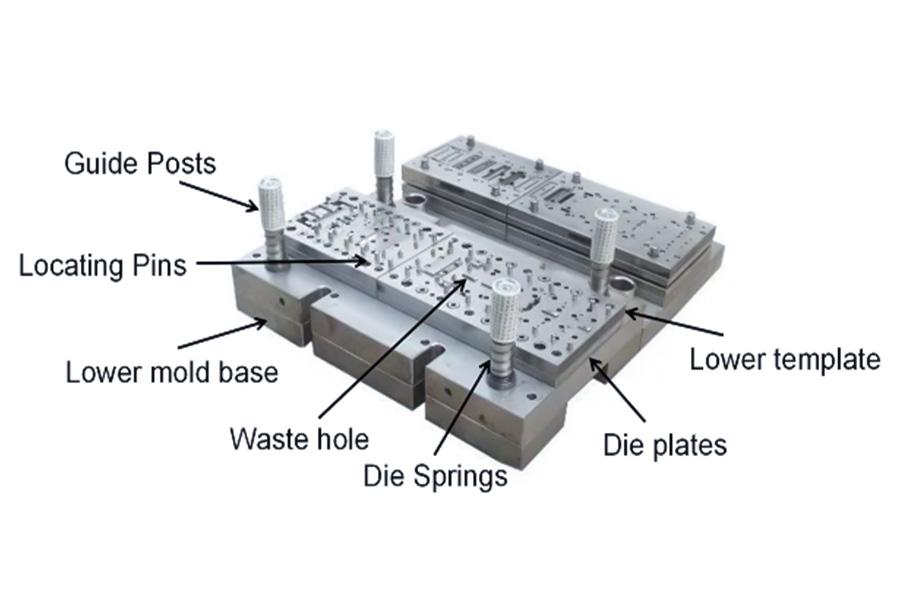
A reliable Progressive Die Design should provide consistent performance throughout long production runs while minimizing downtime, defects, and tooling maintenance. The following ten factors are particularly important when developing a stable progressive stamping tool for automotive applications.
1. Optimize the Strip Layout
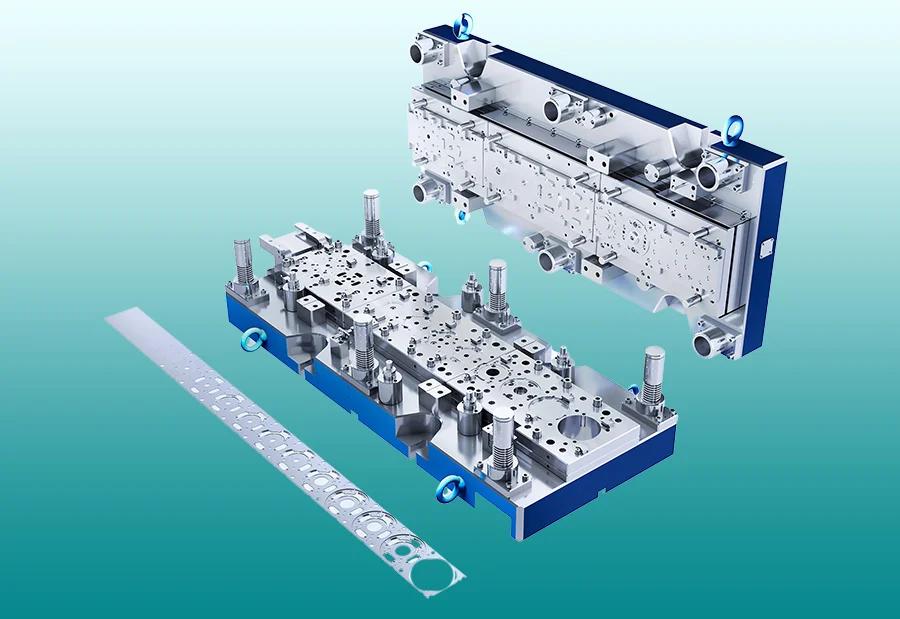
Strip layout is the foundation of an effective Progressive Die Design. It determines how the material moves through each station and how different stamping operations are arranged.
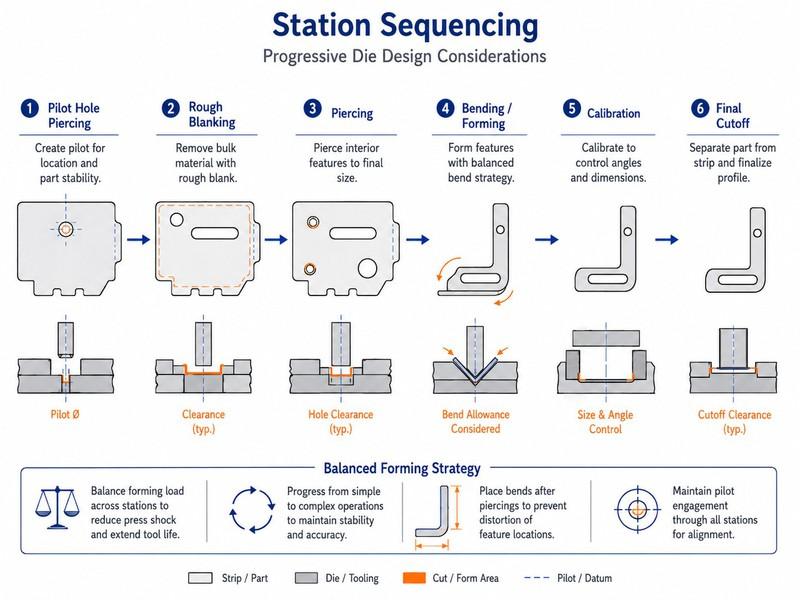
Depending on the component geometry, the process may include piercing, trimming, notching, bending, forming, restriking, and final separation.
The sequence of these operations should be carefully planned to avoid excessive forming loads at individual stations. A balanced layout can improve material utilization, reduce unnecessary deformation, and maintain consistent part quality.
For complex automotive components, engineers should evaluate the complete stamping process before finalizing the strip layout.
2. Ensure Accurate Material Feeding
Accurate feeding is essential for maintaining dimensional consistency during continuous stamping.
The feeding system must deliver the metal strip to every station with a consistent pitch and stable positioning. Important parameters include feed pitch, strip width, material height, feeding speed, and material tension.
Pilot pins can provide additional positioning accuracy by correcting small deviations before critical operations. When feeding equipment and tooling are considered together during Progressive Die Design, the risk of misalignment and production interruptions can be reduced.
Stable feeding is especially important for high-speed stamping applications where even a small positioning error can affect several operations simultaneously.
3. Use a Precision Guiding System
A precision guiding system maintains accurate alignment between the upper and lower die assemblies during repeated production cycles.
Guide posts, guide bushes, guide plates, pilots, and other positioning components help control movement between the die components.
A reliable guiding structure reduces lateral movement and helps maintain consistent cutting and forming conditions. It also minimizes uneven loading on punches, inserts, and forming components.
In precision Progressive Die Design, engineers should consider both initial positioning accuracy and long-term wear resistance. A guiding system that remains stable over extended production can significantly improve tooling reliability.
4. Establish Proper Punching Clearance
Correct punching clearance is another important factor in stable stamping production.
If the clearance is too small, cutting forces can increase and accelerate wear on punches and cutting edges. If the clearance is too large, excessive burrs, poor cut surfaces, and dimensional problems may occur.
The appropriate clearance should be determined according to material type, thickness, mechanical properties, and part quality requirements.
Proper clearance allows the stamping tool to achieve a good balance between cutting quality, component durability, and production efficiency. Clearance should therefore be established during the early stages of Progressive Die Design rather than adjusted only after production problems occur.
5. Control Material Flow During Forming
Material flow has a major influence on the quality and stability of formed automotive components.
During forming, the sheet metal must move in a controlled manner while maintaining the required geometry and mechanical properties. Poor material flow may cause wrinkling, cracking, springback, surface deformation, or dimensional variation.
Engineers should evaluate blank holding, forming radii, forming direction, station sequence, and restriking operations.
For complex components, CAE simulation can be incorporated into Progressive Die Design to identify potential forming problems before the physical tooling is manufactured.
6. Design a Reliable Stripping System
The stripping system plays an important role in continuous stamping operations.
A properly designed stripper plate can control the material, remove the strip from punches, and help maintain smooth movement during each production cycle.
The stripping structure should provide sufficient and evenly distributed force. Spring or nitrogen gas spring arrangements should also be selected according to the required stripping force and operating conditions.
An unstable stripping system can cause material deformation, feeding problems, punch damage, and unexpected downtime.
A reliable stripping structure should therefore be treated as an essential part of Progressive Die Design, particularly for high-speed and high-volume automotive applications.
7. Improve Die Structural Rigidity
A progressive stamping die is exposed to repeated mechanical loads throughout its service life. Sufficient structural rigidity is therefore essential for maintaining long-term dimensional accuracy.
The die structure should be designed according to press capacity, stamping force, material properties, component geometry, and expected production volume.
Important considerations include die plate thickness, tool steel selection, fastener arrangement, supporting structures, and local stress concentration.
When processing high-strength steel or other demanding materials, additional reinforcement may be required in areas exposed to concentrated loads.
A rigid structure is a fundamental requirement of reliable Progressive Die Design because it helps minimize deformation, vibration, and premature component failure.
8. Balance Force Distribution
Multiple stamping operations may generate different levels of force at different stations. Uneven force distribution can negatively affect both the tooling and the press.
Excessive local loading may result in deformation, vibration, accelerated wear, and reduced tooling life.
Engineers should evaluate the force generated by punching, bending, forming, and trimming operations and distribute these operations appropriately throughout the strip layout.
Press tonnage and load distribution should also be considered during Progressive Die Design to ensure that the equipment can handle the combined production load safely and consistently.
9. Design for Easy Maintenance
Long-term production stability depends not only on the original tooling design but also on how easily the die can be inspected and maintained.
Wear components should be designed for convenient replacement and adjustment. Replaceable punches, modular inserts, standardized components, and accessible fastening structures can significantly reduce maintenance time.
A maintenance-friendly stamping tool can provide several benefits, including:
- Reduced production downtime
- Faster replacement of worn components
- Easier troubleshooting
- Lower maintenance costs
- Longer tooling service life
Maintenance requirements should be considered from the beginning of Progressive Die Design rather than treated as an afterthought.
10. Validate the Tool Through CAE and Tryout
The final step toward stable mass production is comprehensive process validation.
CAE analysis can help engineers evaluate material flow, forming limits, thickness reduction, springback, cracking risks, wrinkling risks, and forming forces before the tool enters production.
After machining, T0 and T1 tryouts can be used to identify dimensional, forming, feeding, and stripping issues. Measurement results can then be compared with the required specifications, allowing engineers to optimize the tooling before mass production.
Continuous production testing is also valuable because certain problems may only become visible after the tool has operated for an extended period.
Combining simulation, physical tryout, dimensional inspection, and production validation creates a more reliable Progressive Die Design for demanding automotive applications.
Conclusion
High-stability stamping production is the result of many design factors working together. Strip layout, material feeding, guiding accuracy, punching clearance, material flow, stripping performance, structural rigidity, force distribution, maintenance, and process validation all contribute to tooling reliability.
A successful Progressive Die Design should not only produce accurate parts during initial tryout but also maintain stable performance throughout long-term mass production.
For automotive manufacturers, reliable progressive stamping tooling can help improve production efficiency, reduce scrap, minimize downtime, and extend tooling service life.
TTM provides automotive tooling solutions including progressive dies, stamping dies, checking fixtures, welding fixtures, and precision sheet metal stamping components. By combining practical tooling experience, engineering analysis, precision manufacturing, and quality control, TTM supports customers in developing stable and efficient stamping solutions for demanding automotive production applications.
Post time: Sep-07-2026

.png)
.png)