
Welding is a critical process in automotive manufacturing, particularly for body structures, sheet metal assemblies, brackets, frames, and other components requiring consistent joint quality and dimensional accuracy.
Two widely used technologies are laser welding and arc welding. Both can be integrated into automated production lines, but they differ in heat input, weld characteristics, joint requirements, production speed, and equipment configuration.
Understanding these differences helps manufacturers select an appropriate welding process based on the component design, material, production volume, and quality requirements.
Laser Welding vs. Arc Welding: How Do They Work?
Laser welding uses a concentrated laser beam to generate heat at the joint. The high energy density of the beam allows the material to melt within a relatively small area, producing a narrow and controlled weld.
Arc welding generates heat through an electric arc between the welding electrode and the workpiece. Processes such as MIG/MAG and TIG are widely used in industrial manufacturing. Depending on the process, filler wire may be continuously supplied to form the weld.
The two technologies therefore differ at the fundamental heat-source level. Laser welding concentrates energy into a smaller area, while arc welding generally distributes heat over a larger welding zone.
Heat Input and Thermal Distortion
Heat input is an important consideration when welding automotive sheet metal and precision assemblies.
Because laser energy can be highly concentrated, laser welding can provide a relatively small heat-affected zone and help control thermal deformation when the process parameters and joint conditions are properly managed.
Arc welding generally introduces heat over a larger area. For thin sheet metal or components with tight dimensional tolerances, thermal distortion may therefore require additional consideration.
Actual deformation, however, is influenced by more than the welding technology itself. Material properties, thickness, welding sequence, joint design, clamping conditions, and process parameters all affect the final result.
Welding Speed and Production Cycle
Production speed is another important factor in automated automotive manufacturing.
Laser welding can achieve high welding speeds and is suitable for applications requiring continuous and repeatable automated welding. Its concentrated energy source can also support narrow weld seams and localized heat input.
Arc welding generally operates at lower welding speeds, but robotic MIG/MAG systems provide stable and flexible production for a wide range of automotive components.
When evaluating productivity, manufacturers should consider the complete production cycle rather than welding speed alone. Part loading, positioning, clamping, robot movement, inspection, and unloading can all affect overall cycle time.
Welding Joint and Gap Requirements
Laser welding and arc welding also differ in their tolerance to joint conditions.
Laser welding typically requires accurate component positioning and controlled joint gaps because the laser beam is concentrated over a small area. Excessive or inconsistent gaps can influence penetration and weld formation.
Arc welding is generally more tolerant of variations in joint geometry. The use of filler wire can also help accommodate certain joint gaps and component variations.
This makes welding fixture design particularly important for laser welding applications.
TTM develops automotive welding fixtures designed to locate and support components during welding while providing appropriate access for automated welding equipment.
Material and Thickness Considerations
The selection of welding technology depends heavily on material type, thickness, component geometry, and production requirements.
Laser welding is often considered for thin and medium-thickness sheet metal where high welding speed, localized heat input, and controlled weld geometry are required.
Arc welding remains highly versatile and can be applied to a broad range of component sizes and material thicknesses.
In automotive manufacturing, both processes may therefore be used within the same production environment. A thin sheet metal assembly may use laser welding, while a larger structural component may be processed using robotic MIG/MAG welding.
Laser Welding and Robotic Automation
Laser welding can be integrated into highly automated production cells.
A typical automated laser welding system may include:
- Industrial robot or motion system
- Laser source
- Welding head
- Beam delivery system
- Vision or seam-tracking equipment
- Process monitoring
- Safety enclosure
- Dedicated welding fixture
The combination of laser welding and robotic automation allows manufacturers to achieve repeatable welding paths and stable production conditions.
For high-volume automotive production, automated process monitoring can also help identify variations in welding parameters and support quality control.
Arc Welding and Robotic Welding Cells
Robotic arc welding is widely used for automotive structural assemblies and sheet metal components.
A typical robotic arc welding cell may include:
- Industrial robot
- MIG/MAG welding power source
- Welding torch
- Wire feeder
- Welding fixture
- Positioner
- Shielding gas system
- Safety enclosure
TTM’s robotic welding fixtures and welding stations are developed for automated automotive production, combining component positioning, fixture systems, robotic welding, and production-line requirements.
Compared with manual welding, robotic systems provide repeatable torch movement, consistent welding parameters, and improved production stability.
The Role of Welding Fixtures in Automated Welding
Whether laser welding or arc welding is selected, the welding fixture is an important part of the overall production system.
A welding fixture is responsible for accurately locating and supporting components throughout the welding process. It must maintain the required part position while allowing sufficient access for the laser head or welding torch.
For laser welding, fixture accuracy can be especially important because the concentrated laser beam requires precise alignment with the joint.
For robotic arc welding, the fixture must provide stable positioning while allowing the robot to reach all required welding points.
A well-designed automated welding fixture can help control:
- Part positioning
- Joint gap
- Assembly repeatability
- Welding accessibility
- Thermal movement
- Robot accessibility
- Production cycle time
The fixture should therefore be considered together with the welding process rather than as a separate manufacturing step.
Robotic Welding Workstations for Automotive Manufacturing
For automated production, welding fixtures are normally integrated with robots, welding equipment, safety systems, and part-handling systems to form a complete welding workstation.
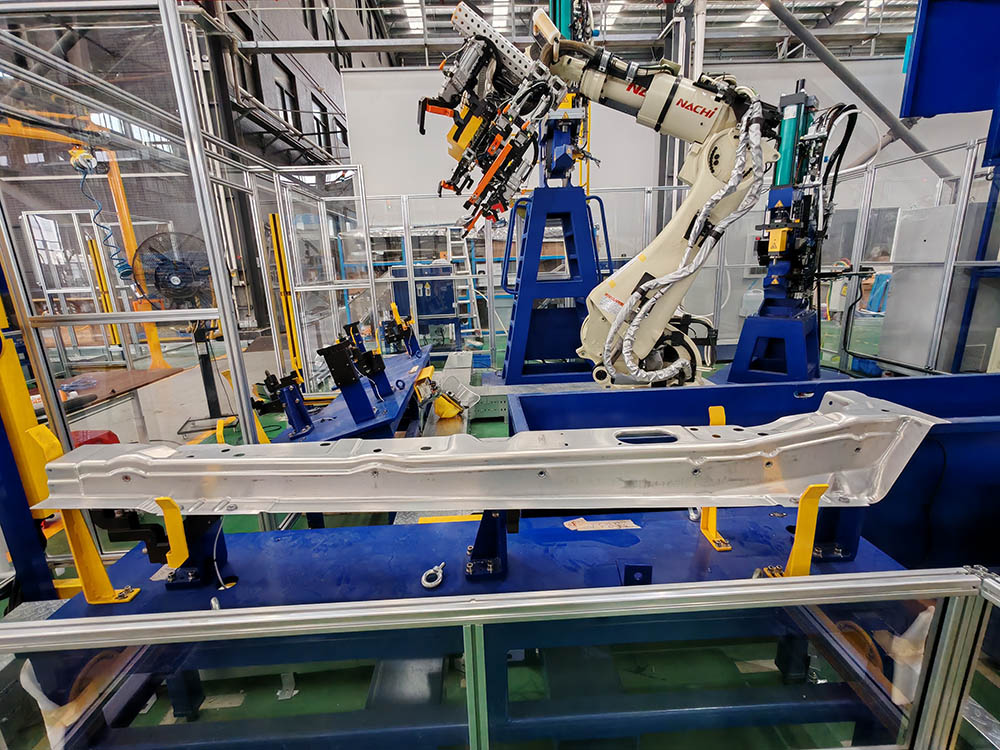
For example, TTM has developed a robotic welding workstation for electric commercial vehicle manufacturing integrating customized welding fixture design, robotic welding, positioning systems, and production-line optimization.
The project demonstrates how fixture rigidity, component positioning, robot accessibility, welding sequence, and cycle time need to be considered together when developing an automated welding solution.
Laser Welding vs. Arc Welding: Key Differences
| Factor | Laser Welding | Arc Welding |
|---|---|---|
| Heat source | Concentrated laser beam | Electric arc |
| Heat distribution | Highly localized | Generally broader |
| Welding speed | Generally high | Moderate to high depending on process |
| Weld width | Typically narrow | Generally wider |
| Joint gap tolerance | More sensitive | Generally more tolerant |
| Filler material | Often not required | Commonly used |
| Automation | Highly suitable | Highly suitable |
| Fixture accuracy | Particularly important | Important |
| Typical applications | Precision sheet metal, high-speed automated welding | Structural assemblies, brackets, frames, general fabrication |
The actual performance of either process depends on material, joint design, welding parameters, equipment configuration, and production conditions.
Selecting the Right Welding Process
There is no single welding technology suitable for every automotive component.
Laser welding may be appropriate when the application requires:
- High production speed
- Controlled heat input
- Narrow weld seams
- Low thermal distortion
- Precise automated welding
- Consistent component positioning
Arc welding may be appropriate when the application requires:
- Greater flexibility in joint configuration
- Wider tolerance for joint gaps
- Filler material
- Structural welding
- A broad range of material thicknesses
- Flexible robotic welding production
In many manufacturing facilities, laser welding and arc welding are complementary technologies rather than direct substitutes.
Integrating Welding, Fixtures and Automation
For automotive manufacturers, welding quality depends on the interaction between multiple elements of the production system.
The welding process, fixture design, robotic movement, component tolerances, process parameters, and quality inspection must work together.
TTM provides automotive manufacturing solutions covering welding fixtures, checking fixtures, stamping dies, and automation equipment. This allows different tooling and automation requirements to be considered as part of the overall manufacturing process.
For automated welding applications, fixture positioning, robot accessibility, welding sequence, and production efficiency can be evaluated during the development stage.
This integrated approach helps manufacturers establish stable and repeatable welding processes for automotive production.
Conclusion
Laser welding and arc welding each have distinct technical characteristics and application advantages.
Laser welding provides highly concentrated energy, high welding speed, and controlled weld geometry, making it suitable for many precision and automated sheet metal applications.
Arc welding offers process flexibility and broad application coverage, making it a practical solution for many structural and automotive assemblies.
The appropriate choice should be based on the complete manufacturing requirement rather than the welding technology alone. Material, thickness, joint design, dimensional tolerances, fixture accuracy, robot accessibility, production volume, and quality requirements should all be evaluated before selecting the final process.
For automated automotive manufacturing, the combination of welding technology, welding fixtures, robotic systems, and process control is fundamental to achieving stable production and consistent weld quality.
Post time: Sep-29-2026

.png)
.png)