
The rapid growth of electric vehicles has created increasing demand for efficient, reliable, and highly automated battery manufacturing solutions. As electric vehicle battery packs become more complex, manufacturers need production systems capable of handling precise welding, accurate positioning, stable electrical connections, and consistent quality control.
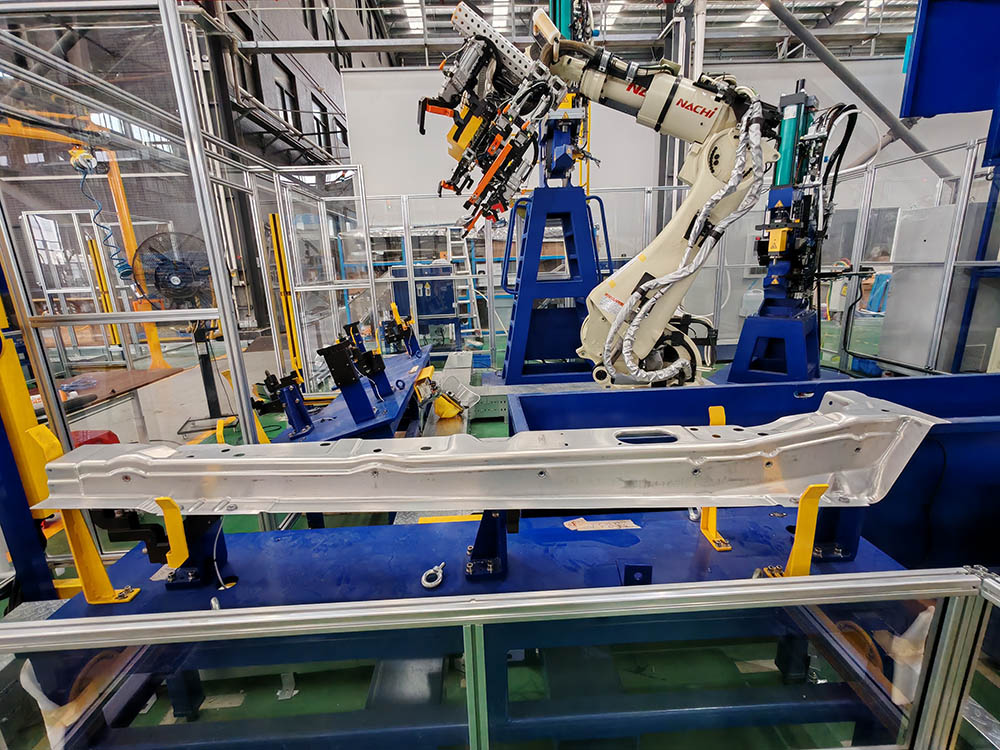
An EV Battery Welding Production Line integrates welding equipment, automation systems, fixtures, material handling, inspection equipment, and production control technologies into a coordinated manufacturing process. By automating critical welding operations, manufacturers can improve production efficiency while maintaining consistent welding quality across large production volumes.
Battery welding is particularly important because electrical and mechanical connections inside a battery module or pack must meet strict performance requirements. A poorly controlled weld can affect electrical conductivity, mechanical strength, thermal performance, and long-term reliability. Therefore, the design of an EV Battery Welding Production Line must consider not only welding technology but also positioning accuracy, process monitoring, inspection, traceability, and production safety.
What Is an EV Battery Welding Production Line?
An EV Battery Welding Production Line is an integrated manufacturing system designed to perform automated welding and assembly operations for electric vehicle battery components.
Depending on the battery architecture and customer requirements, the production line may be used for battery cells, battery modules, battery packs, busbars, connectors, cooling components, structural parts, and other battery-related assemblies.
A typical line may include:
- Automatic material loading
- Cell or component positioning
- Battery welding fixtures
- Robotic welding systems
- Laser welding equipment
- Resistance welding equipment
- Busbar welding stations
- Battery module assembly stations
- Vision inspection
- Electrical testing
- Dimensional inspection
- Automatic material transfer
- Production data collection
- Safety and process control systems
The exact configuration depends on battery type, production capacity, component geometry, welding technology, and customer requirements.
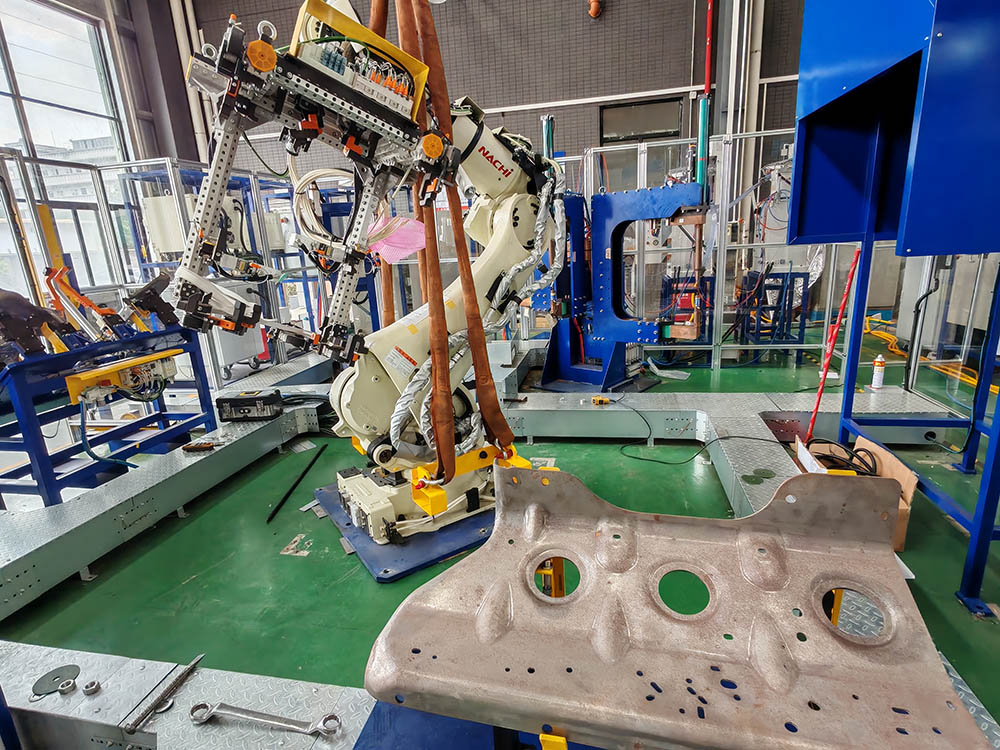
Why Welding Is Important in EV Battery Manufacturing
Welding is one of the key joining technologies used in electric vehicle battery manufacturing.
Battery cells and related electrical components require reliable connections with controlled electrical resistance and sufficient mechanical strength. At the same time, the welding process must avoid excessive heat that could negatively affect sensitive battery components.
This creates a demanding manufacturing environment.
An effective EV Battery Welding Production Line must therefore provide accurate positioning and carefully controlled welding parameters.
The welding process may need to control current, voltage, pulse duration, welding speed, laser power, electrode pressure, or other parameters depending on the selected technology.
Stable process control is essential because small variations can potentially influence the performance of the finished battery assembly.
Main Welding Technologies for EV Batteries
Different battery components require different welding methods.
Laser Welding
Laser welding is widely used in applications requiring precise, localized heat input.
A laser welding system can produce concentrated energy at the welding area, making it suitable for components where dimensional accuracy and controlled thermal input are important.
Laser welding may be applied to battery tabs, busbars, terminals, covers, and other battery components.
Resistance Welding
Resistance welding uses electrical current and pressure to generate heat at the contact area.
It can provide fast and repeatable welding cycles and is suitable for high-volume manufacturing.
Resistance welding can be integrated into automated battery welding production line solutions where large numbers of repeated welds are required.
Robotic Welding
For structural battery components and larger assemblies, robotic welding can provide automated movement and repeatable welding paths.
A robotic welding system can be combined with dedicated fixtures, positioners, sensors, and inspection equipment to create an integrated automated workstation.
The selection of welding technology depends on material, thickness, joint design, production volume, required weld quality, and battery architecture.
How an EV Battery Welding Production Line Works
A complete EV Battery Welding Production Line normally operates through a sequence of automated manufacturing stages.
First, battery cells or components are loaded into the production system.
The components are then transferred to a positioning station where locating devices and fixtures establish the required relationship between individual components.
Next, the welding station performs the programmed joining operation.
After welding, inspection equipment verifies the weld or component condition.
The finished assembly is then transferred to the next process.
A simplified workflow can be represented as:
Loading → Positioning → Clamping → Welding → Inspection → Testing → Transfer → Final Assembly
Automation systems coordinate each stage to ensure that the production sequence is completed correctly.
Sensors can confirm component presence, fixture status, clamp position, and other process conditions before welding begins.
The Importance of Battery Welding Fixtures
Fixtures are a critical part of any automated battery manufacturing system.
A battery welding fixture positions components accurately and keeps them stable during welding.
For an EV Battery Welding Production Line, fixture accuracy can directly affect welding quality.
If the component is incorrectly positioned, the welding tool may not align with the intended joint. This can lead to inconsistent weld geometry or other quality problems.
A properly designed fixture should provide:
- Accurate positioning
- Stable support
- Repeatable clamping
- Easy loading and unloading
- Welding accessibility
- Minimal component deformation
- Compatibility with automation equipment
Fixture design must also consider maintenance and replacement.
Because production lines operate continuously, fixtures should be designed for durability and convenient service.
Automation and Robotic Integration
Modern battery manufacturing increasingly relies on automation.
A complete battery welding automation system can combine robots, welding equipment, fixtures, conveyors, sensors, inspection systems, and production control software.
Robots can handle repetitive material transfer and welding operations.
Automatic fixtures can position and clamp components.
Sensors can verify whether components are correctly loaded.
Inspection systems can evaluate welding results.
The control system coordinates these operations and determines whether the production cycle can continue.
This integrated approach reduces manual intervention and improves production repeatability.
attery Module Welding
Battery modules contain multiple cells connected through electrical and structural components.
The welding process used for module production must maintain consistent positioning and reliable electrical connections.
A battery module welding station may integrate cell positioning, busbar placement, welding, inspection, and data recording.
Depending on the module design, welding may be performed using laser, resistance, or other specialized joining technologies.
Automation becomes particularly valuable when a module contains a large number of repeated welding points.
Instead of relying on manual operations, an automated system can perform the same welding sequence repeatedly according to predefined process parameters.
Battery Pack Welding
Battery packs are larger assemblies that may contain multiple modules, electrical connections, cooling systems, structural components, and protective housings.
Welding may be required for structural components, brackets, housings, cooling-related parts, and other assemblies.
A battery pack welding system must consider the size and geometry of the complete assembly.
The welding system may therefore require larger fixtures, robotic systems, positioners, material handling equipment, and integrated inspection stations.
The objective is to maintain dimensional accuracy while achieving the required production cycle time.
Quality Control in EV Battery Welding
Quality control is a fundamental part of an EV Battery Welding Production Line.
Because battery assemblies are safety-critical products, welding quality must be controlled carefully.
Depending on the application, inspection may include:
- Weld appearance inspection
- Weld position inspection
- Weld dimension inspection
- Electrical resistance testing
- Pull or tensile testing
- Vision inspection
- Dimensional inspection
- Leak testing
- Electrical continuity testing
- Process parameter monitoring
Automated inspection can be integrated directly into the production line.
For example, a vision system can inspect weld locations immediately after the welding operation.
If a problem is detected, the production control system can identify the affected component and prevent it from continuing to the next production stage.
Process Monitoring and Traceability
Modern EV battery manufacturing increasingly requires complete production traceability.
A well-designed EV Battery Welding Production Line can collect information from each production cycle.
Data may include:
- Production time
- Welding parameters
- Component identification
- Machine status
- Inspection results
- Error information
- Operator information
- Production batch
- Equipment maintenance status
Barcode scanners or other identification systems can connect production data with individual components or battery assemblies.
This allows manufacturers to track production history and investigate quality issues more efficiently.
Traceability is particularly important when manufacturers need to analyze a quality problem and determine which production conditions may have contributed to it.
Safety Considerations
Battery manufacturing requires careful consideration of production safety.
The design of an EV Battery Welding Production Line should include appropriate safety systems based on the battery chemistry, process technology, equipment configuration, and applicable customer standards.
Safety functions may include:
- Safety fencing
- Interlocked doors
- Emergency stop systems
- Equipment monitoring
- Protective enclosures
- Process alarms
- Automated fault detection
- Controlled material handling
For automated welding systems, safety should be considered from the beginning of the engineering process rather than added after equipment
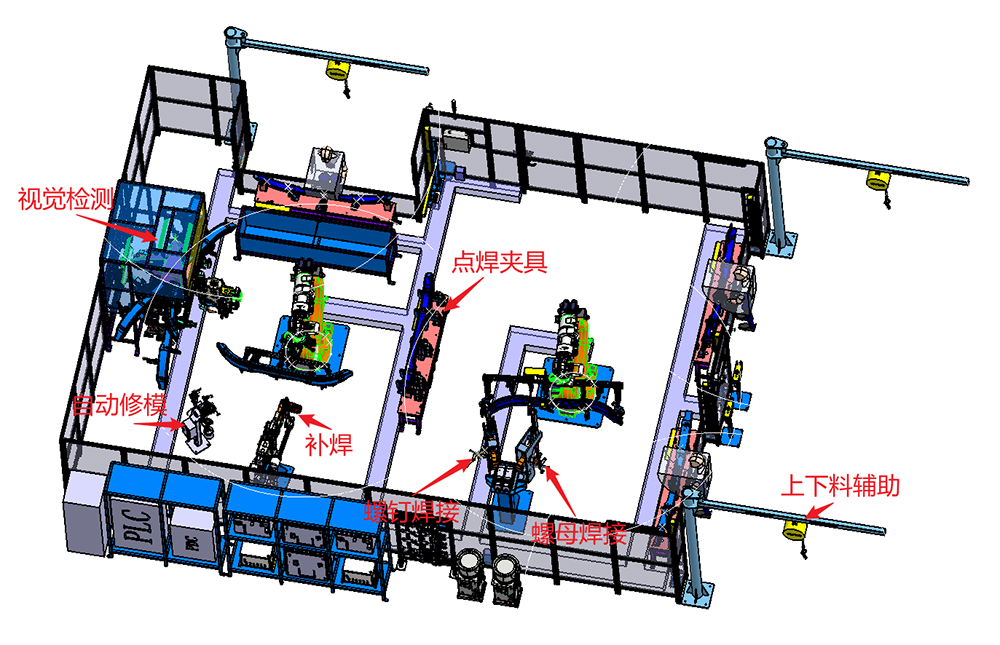
development.
Improving Production Efficiency
One of the primary reasons manufacturers invest in an EV Battery Welding Production Line is to improve production efficiency.
Automation can reduce repetitive manual operations and provide consistent production cycles.
For example, automatic loading and unloading can reduce handling time.
Robotic welding can maintain programmed movement and process parameters.
Automatic inspection can reduce the time required for manual quality checks.
Integrated production control can also reduce unnecessary waiting between different manufacturing stages.
When these technologies work together, the overall production cycle can become more efficient.
Improving Welding Consistency
Consistency is another major benefit of automated battery welding.
Manual welding can be affected by operator experience, fatigue, positioning differences, and variations in process execution.
An automated EV Battery Welding Production Line can standardize the welding sequence.
The welding equipment operates according to predefined parameters while fixtures maintain consistent component positioning.
Robots or automated welding heads follow programmed paths.
Sensors monitor critical production conditions.
This combination can reduce process variation and provide more consistent welding results.
Flexible Production for Different Battery Components
Electric vehicle battery designs continue to evolve.
Different manufacturers may use different cell formats, module structures, busbar configurations, and battery pack architectures.
For this reason, flexibility is becoming increasingly important when designing an EV Battery Welding Production Line.
A flexible production system can be designed with modular fixtures, adjustable tooling, programmable robots, and configurable inspection systems.
This can make it easier to adapt the production line to new components or future product requirements.
Modular automation can also help manufacturers expand production capacity without completely rebuilding an existing system.
Integration With Battery Assembly Lines
Welding is normally only one stage of battery manufacturing.
A complete EV battery production line may include several additional operations.
For example:
Cell Loading → Cell Positioning → Module Assembly → Welding → Inspection → Electrical Testing → Pack Assembly → Final Testing
Integrating the welding process with these operations can improve production flow.
Material transfer systems can automatically move components between stations.
Production control systems can coordinate equipment status.
Inspection results can be shared with manufacturing databases.
This creates a connected production environment rather than a collection of independent machines.
The Role of Data in Battery Manufacturing
Data is becoming increasingly important in advanced battery production.
A modern EV Battery Welding Production Line can generate large amounts of process information.
Manufacturers can analyze this data to identify production trends and potential sources of variation.
For example, if welding parameters gradually change over time, maintenance teams can investigate equipment conditions.
If inspection results show increasing variation in a particular welding position, engineers can check fixture alignment or component positioning.
This approach allows manufacturers to move from reactive maintenance toward preventive process management.
Designing an EV Battery Welding Production Line
Designing a complete production line requires coordination between mechanical engineering, welding engineering, automation, electrical control, fixture design, and quality engineering.
Important factors include:
- Battery component design
- Welding technology
- Production volume
- Required cycle time
- Component positioning
- Fixture structure
- Robot reach
- Welding accessibility
- Inspection requirements
- Traceability requirements
- Safety requirements
- Maintenance requirements
- Future production flexibility
A successful production line must balance production speed with welding quality.
Increasing speed without controlling positioning and process parameters may create quality problems.
Likewise, an overly complex system may increase investment and maintenance requirements.
The best solution is therefore a system designed around the customer’s actual production objectives.
TTM EV Battery Welding Automation Solutions
TTM provides customized automation and welding solutions for EV battery and automotive manufacturing applications.
As an experienced automation and welding solution provider, TTM can integrate welding equipment, robotic systems, dedicated fixtures, clamping systems, material handling, inspection equipment, and production control technologies.
For an EV Battery Welding Production Line, TTM can develop solutions according to component geometry, welding requirements, production volume, cycle time, and customer quality standards.
The engineering process can cover fixture design, equipment integration, automation programming, production-line layout, welding process integration, inspection, and final commissioning.
TTM also focuses on integrating welding and inspection into a complete manufacturing process.
By connecting battery welding automation, fixture technology, robotic systems, and inspection equipment, the production line can provide a more consistent and traceable manufacturing environment.
Future Trends in EV Battery Welding
As electric vehicle production continues to develop, battery manufacturing will become increasingly automated and data-driven.
Future EV Battery Welding Production Line solutions are expected to place greater emphasis on intelligent inspection, real-time process monitoring, flexible production, digital traceability, and automated material handling.
Vision systems and sensors can provide more detailed information about component positioning and welding conditions.
Robotic systems can become more flexible through improved programming and sensing technologies.
Production data can be analyzed to identify process trends and optimize equipment performance.
These developments will help manufacturers build more efficient and reliable battery manufacturing operations.
Conclusion
An EV Battery Welding Production Line is more than a collection of welding machines. It is an integrated manufacturing system that combines welding technology, fixtures, automation, inspection, material handling, control systems, and production data.
The effectiveness of the line depends on how these systems work together.
Accurate fixtures ensure stable positioning. Automated welding systems provide repeatable joining operations. Sensors and inspection systems support quality control. Production data provides traceability and helps engineers identify process variation.
For electric vehicle manufacturers, these capabilities are becoming increasingly important as battery production volumes increase and quality requirements become more demanding.
By implementing a properly engineered EV Battery Welding Production Line, manufacturers can improve welding consistency, production efficiency, process traceability, and overall manufacturing control.
TTM supports customers with customized EV Battery Welding Production Line, battery welding automation, robotic welding, welding fixture, and automotive automation solutions, helping manufacturers develop reliable and scalable production systems for the rapidly evolving electric vehicle industry.
Post time: Aug-31-2026

.png)
.png)