
In modern manufacturing, welding technology plays an essential role in automotive production, sheet metal fabrication, and precision metal assembly. As manufacturers continue to improve production efficiency and welding quality, choosing the right welding equipment becomes increasingly important.
Two commonly used technologies are the Energy Storage Welding Machine and the traditional resistance spot welding machine. Although both systems use resistance welding principles to generate heat and create strong joints, their working methods, energy consumption, welding performance, and application fields are different.
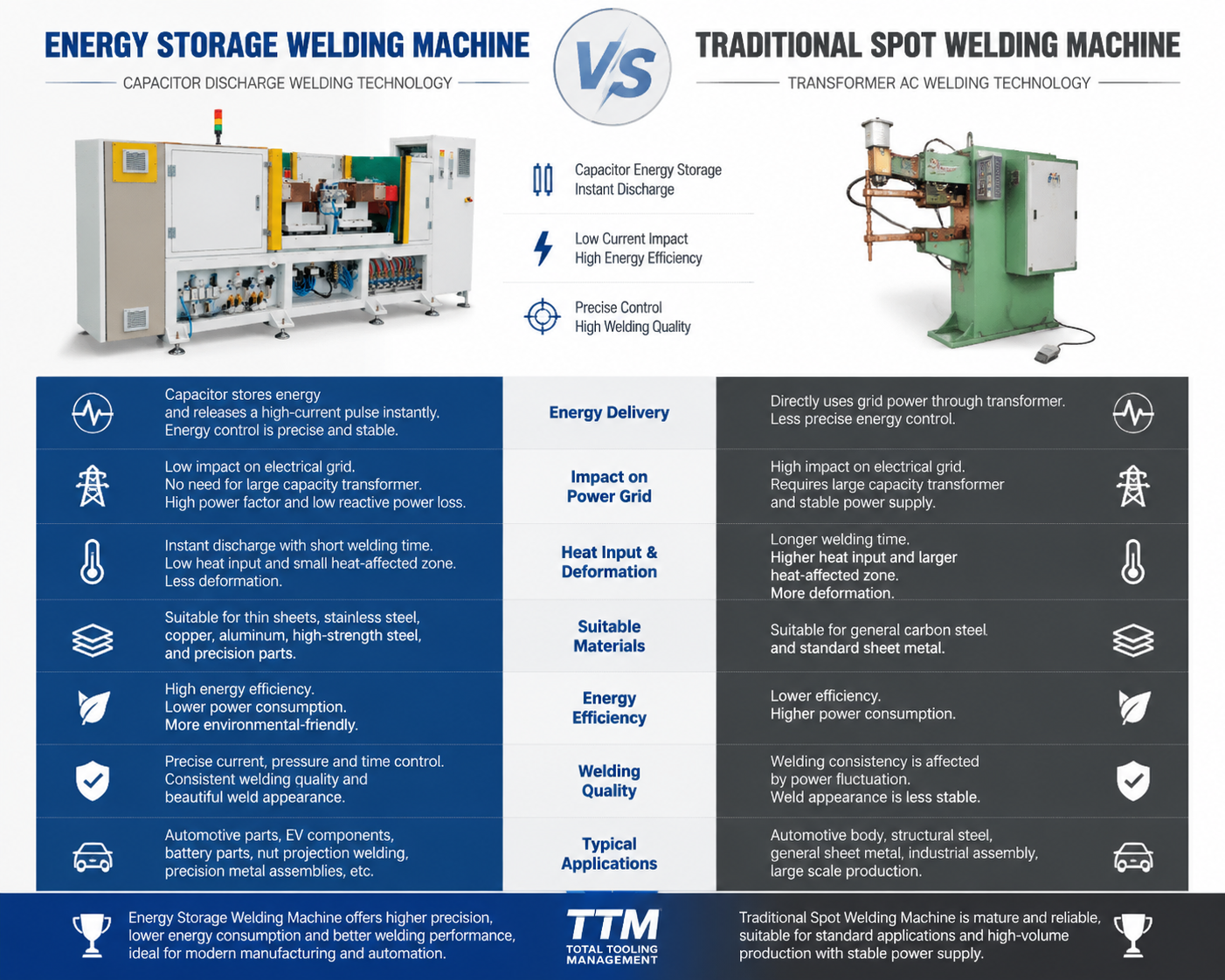
Understanding the differences between an Energy Storage Welding Machine vs Traditional Spot Welding Machine can help manufacturers select the most suitable welding solution for their production requirements.
What Is an Energy Storage Welding Machine?
An Energy Storage Welding Machine is a welding system that uses capacitor energy storage technology. During operation, electrical energy is stored inside capacitors first. When welding starts, the stored energy is released instantly as a high-current pulse to complete the welding process.
This capacitor discharge welding method provides concentrated energy output within a very short period, reducing heat input and improving welding precision.
The technology is widely used for:
- Automotive sheet metal components
- High-strength steel parts
- Stainless steel welding
- Copper and aluminum welding
- Nut projection welding
- Precision metal assemblies
What Is a Traditional Spot Welding Machine?
A traditional spot welding machine, also known as a resistance spot welding machine, usually uses a transformer to continuously supply welding current.
During welding, electrical energy passes through the workpieces, generating resistance heat between metal contact points. The heat melts the contact area and forms a welded joint.
Traditional spot welding machines are commonly used in:
- Automotive body welding
- Steel structure manufacturing
- General sheet metal production
- Industrial assembly applications
While traditional spot welding technology is mature and reliable, it may require higher electrical power and generate more heat during the welding process.
Energy Storage Welding Machine vs Traditional Spot Welding Machine
1. Welding Energy Control
The biggest difference between an Energy Storage Welding Machine vs Traditional Spot Welding Machine is the method of energy delivery.
An energy storage welding system stores electrical energy in advance and releases it as a controlled pulse. The welding energy can be adjusted accurately according to different materials and thicknesses.
Traditional spot welding machines directly draw power from the electrical grid during welding, making energy control more dependent on transformer performance and power supply stability.
For precision welding applications, the energy storage system provides better control and repeatability.
2. Impact on Electrical Grid
An Energy Storage Welding Machine has a significant advantage in reducing electrical load.
Because the welding energy is stored before discharge, the instantaneous demand from the factory power network is much lower. The equipment does not require an oversized transformer, and the impact on the electrical grid is minimized.
Traditional spot welding machines usually require higher electrical capacity, especially when multiple welding stations operate simultaneously.
3. Heat Input and Workpiece Deformation
Heat control is another important difference between these two welding technologies.
The capacitor discharge process of an Energy Storage Spot Welding Machine releases energy in milliseconds. This creates a smaller heat-affected zone and reduces deformation.
Advantages include:
- Better welding appearance
- Less material distortion
- Improved dimensional accuracy
- Higher welding consistency
Traditional spot welding machines generally have longer welding cycles, which may produce more heat accumulation during continuous production.
4. Welding of Thin and Precision Materials
For thin sheet metal and precision components, an energy storage system provides better performance.
The short-duration high-current pulse allows the machine to weld materials such as:
- Thin steel sheets
- Stainless steel plates
- Copper components
- Aluminum parts
- Small precision assemblies
Traditional spot welding may require more adjustment to prevent overheating or surface damage when processing sensitive materials.
5. Energy Efficiency
Energy efficiency is becoming increasingly important for manufacturers.
An Energy Storage Welding Machine uses capacitor discharge technology, which improves power utilization and reduces unnecessary energy consumption.
Compared with traditional resistance welding equipment, it offers:
- Lower reactive power loss
- Higher power factor
- Reduced electricity consumption
- Better environmental performance
This makes it suitable for modern low-carbon manufacturing environments.
Applications in Automotive Manufacturing
The automotive industry has increasing requirements for welding high-strength materials and lightweight structures.
An Energy Storage Welding Machine is widely used for:
- Automotive brackets
- Battery-related components
- High-strength steel parts
- Hot stamping steel components
- Sheet metal housings
- Automotive nut welding
For electric vehicle and advanced automotive manufacturing, precise welding control is essential to ensure product reliability and safety.
Which Welding Machine Should You Choose?
When comparing Energy Storage Welding Machine vs Traditional Spot Welding Machine, the best choice depends on the production requirements.
Traditional spot welding machines remain a reliable solution for standard welding applications requiring high production capacity.
However, for manufacturers requiring:
- High welding precision
- Low heat input
- Thin material welding
- Energy efficiency
- Stable welding quality
an Energy Storage Welding Machine provides significant advantages.
TTM Energy Storage Welding Machine Solutions
TTM provides customized welding equipment and automation solutions for automotive and industrial manufacturing.
Our Energy Storage Welding Machine integrates advanced capacitor discharge technology with professional welding engineering experience to deliver reliable and efficient welding solutions.
From automotive components and sheet metal parts to precision metal assemblies, TTM helps manufacturers improve welding quality, reduce energy consumption, and achieve stable production performance.
Choosing the right welding technology is essential for future manufacturing. With its advantages in precision, efficiency, and energy saving, the Energy Storage Welding Machine has become an ideal solution for modern automotive welding applications.
Post time: Aug-24-2026

.png)
.png)