
Automotive welding methods is one of the most important manufacturing processes in the automotive industry. It plays a critical role in connecting vehicle body structures, stamped components, chassis parts, and functional assemblies.
With the rapid development of lightweight vehicles, electric vehicles, and smart manufacturing, automotive manufacturers require advanced welding technologies that provide high strength, excellent precision, stable quality, and efficient production performance.
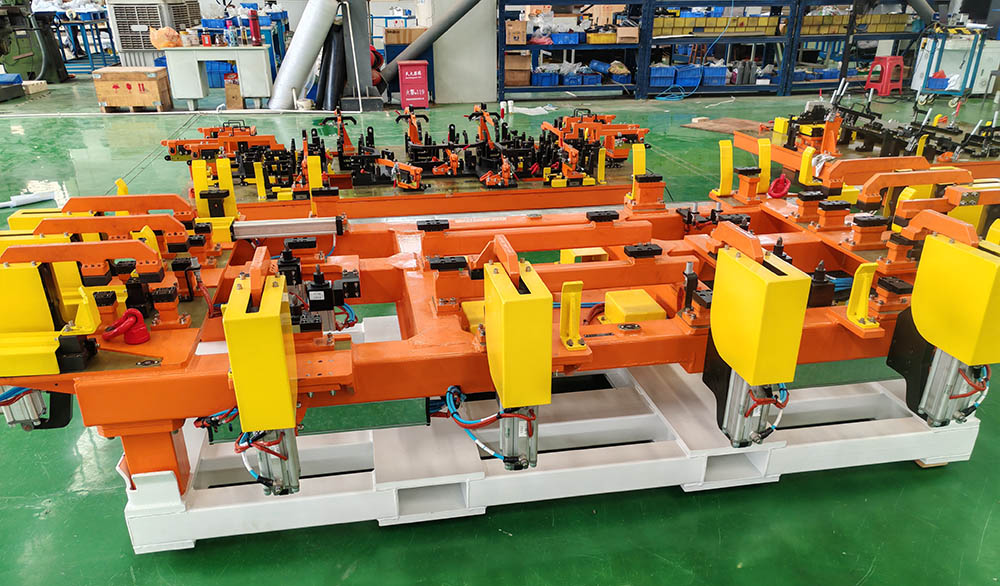
Different automotive welding methods are selected according to material type, component structure, production volume, and quality requirements. Common applications include body-in-white (BIW), automotive structural parts, battery trays, chassis components, and interior assemblies.
1. Spot Welding – The Most Common Automotive Welding Process
Spot welding is one of the most widely used welding methods in automotive manufacturing.
This process uses welding electrodes to apply pressure and electrical current to metal sheets. The resistance heat generated between the contact surfaces melts the material and forms a strong weld joint.
Advantages of Spot Welding:
- High welding speed;
- Excellent production efficiency;
- Suitable for mass production;
- Easy integration with robotic systems.
Typical Applications:
- Body-in-white structures;
- Door inner panels;
- Side body assemblies;
- Floor panels;
- Crash safety components.
Modern vehicle production lines commonly use robotic spot welding systems and automated welding cells to achieve continuous and reliable production.
2. Projection Welding – Precision Welding for Automotive Components
Projection welding is a specialized form of resistance welding. Unlike traditional spot welding, current is concentrated through designed projections on the component surface.
Key Features:
- Accurate welding location;
- Multiple weld points can be completed simultaneously;
- Suitable for small components.
Applications:
- Automotive nuts and studs;
- Brackets;
- Reinforcement components;
- Sheet metal assemblies.
Projection welding is widely used for automotive parts that require reliable fastening and repeatable welding quality.
3. MIG/MAG Welding – High Strength Welding for Structural Components
MIG/MAG welding (Metal Inert Gas / Metal Active Gas Welding) is a welding process that uses a continuous wire electrode and shielding gas.
It is commonly used for thicker materials and structural components requiring high welding strength.
Benefits:
- Strong and durable weld joints;
- Suitable for steel and aluminum materials;
- Flexible operation;
- Stable welding performance.
Automotive Applications:
- Chassis components;
- Battery trays;
- Exhaust systems;
- Commercial vehicle structures.
As electric vehicles continue to grow, MIG/MAG welding is becoming increasingly important for lightweight aluminum and high-strength steel applications.
4. Laser Welding – High Precision Automotive Welding Technology
Laser welding uses a high-energy laser beam to melt and join materials with excellent accuracy.
As an advanced automotive welding technology, laser welding provides outstanding advantages:
- High welding precision;
- Small heat-affected area;
- Reduced deformation;
- High automation compatibility.
Common Applications:
- Battery enclosures;
- Battery trays;
- High-strength vehicle structures;
- Lightweight body components.
Laser welding is especially valuable for new energy vehicle manufacturing where weight reduction and structural strength are critical.
5. Tailor Welded Blank (TWB) – Supporting Automotive Lightweight Design
Tailor Welded Blank technology combines sheets with different thicknesses or material properties through laser welding before stamping.
Advantages:
- Reduces vehicle weight;
- Improves structural performance;
- Optimizes material usage.
Applications:
- Door inner panels;
- Side structures;
- Floor components;
- Safety reinforcement parts.
TWB technology helps automotive manufacturers achieve lightweight designs while maintaining vehicle safety performance.
6. Ultrasonic Welding – Efficient Joining for Electric Vehicle Components
Ultrasonic welding uses high-frequency vibration energy to create friction heat between materials and form a solid connection.
Features:
- Fast welding speed;
- Low heat impact;
- No traditional welding filler required.
Applications:
- Battery connections;
- Electrical harnesses;
- Plastic automotive components.
Ultrasonic welding is increasingly used in electric vehicle battery manufacturing.
7. Friction Stir Welding (FSW) – Advanced Aluminum Joining Technology
Friction Stir Welding is a solid-state welding process where a rotating tool generates friction heat and mechanically joins materials without melting the base metal.
Advantages:
- Excellent weld quality;
- Low defect rate;
- Ideal for aluminum alloys.
Applications:
- EV battery trays;
- Aluminum body structures;
- Lightweight automotive components.
8. Brazing – Precision Joining for Automotive Systems
Brazing uses a filler metal with a lower melting point than the base materials to join components.
Benefits:
- Minimal base material deformation;
- Good surface quality;
- Suitable for precision assemblies.
Applications:
- Automotive heat exchangers;
- Cooling systems;
- Air conditioning components.
Comparison of Common Automotive Welding Methods
| Welding Method | Main Advantages | Typical Applications |
|---|---|---|
| Spot Welding | Fast and highly automated | Body-in-white |
| Projection Welding | Accurate small-part welding | Nuts, studs, brackets |
| MIG/MAG Welding | Strong structural joints | Chassis, battery trays |
| Laser Welding | High precision and low deformation | EV structures |
| TWB Welding | Lightweight design | Safety components |
| Ultrasonic Welding | Fast and low heat impact | Batteries, wiring |
| Friction Stir Welding | High-quality aluminum joining | Battery trays |
| Brazing | Precision connection | Thermal systems |
The Future Trend of Automotive Welding Technology
With the development of Industry 4.0 and smart manufacturing, automotive welding processes are becoming increasingly automated and intelligent.
Future automotive welding production will focus on:
- Robotic welding systems;
- Automated welding cells;
- Flexible manufacturing lines;
- Vision inspection technology;
- Digital quality monitoring;
- Real-time production data tracking.
Modern automotive production often integrates:
- Automotive Welding Fixtures
- Welding Checking Fixtures
- Automated Welding Cells
to ensure welding accuracy, improve production efficiency, and maintain consistent quality.
Conclusion
Choosing the right automotive welding methods is essential for achieving high-quality vehicle manufacturing. From traditional spot welding to advanced laser welding and friction stir welding, each technology provides unique advantages for different automotive applications.
For global automotive OEMs and Tier 1 suppliers, advanced welding technologies combined with precision tooling solutions help improve production efficiency, reduce manufacturing costs, and achieve reliable vehicle quality.
HONGXING provides professional automotive tooling solutions, including automotive welding fixtures, checking fixtures, and automated welding systems, supporting customers worldwide with efficient and reliable manufacturing solutions.
Post time: Aug-17-2026

.png)
.png)