
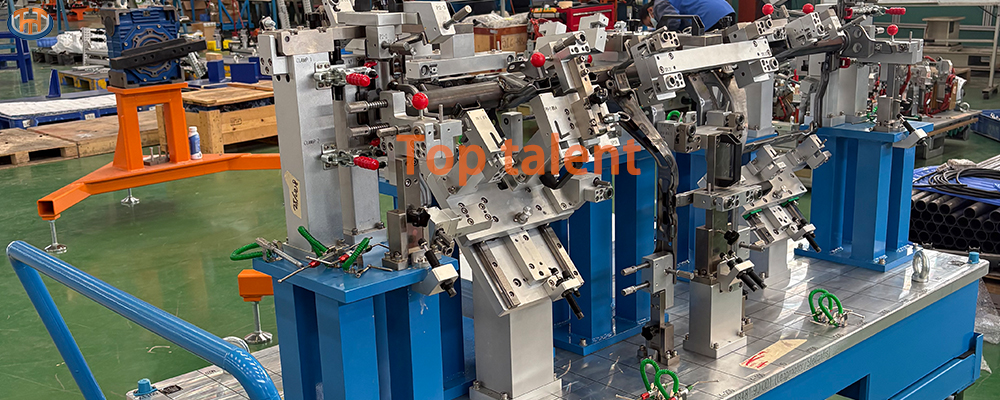
In the high-stakes world of automotive manufacturing, where tolerances are measured in fractions of a millimeter, a single flawed component can disrupt an entire assembly line or compromise vehicle safety. This is where a specialized, often unsung hero comes into play: the Car Configuration Build (CCB) Checking Fixture. Far more than a simple template, this precision tool is fundamental to ensuring quality, consistency, and efficiency from prototype to full-scale production.
What is a CCB Checking Fixture?
A CCB checking fixture is a custom-made, physical measurement device designed to verify the dimensional accuracy of a specific automotive part or assembly. Built to exacting standards, it acts as a “master gauge” against which production parts are compared. These fixtures are typically constructed from high-stability materials like aluminum and steel, and incorporate precisely located pins, clamps, and sensors. They are engineered to hold a component in its nominal position—exactly as it was designed in the CAD model—allowing quality engineers to perform comprehensive checks.
Key Functions and Benefits in the Automotive Process
1. First Article Inspection (FAI): The CCB fixture is indispensable during the launch of a new model or part. It is used to validate the very first parts off a production tool, confirming that dies, molds, and assembly processes are capable of producing components within specification.
2. Dimensional Control: It provides a rapid, repeatable method for measuring critical parameters like hole locations, surface contours, edge flanges, and overall geometry. This is faster and often more practical for shop-floor use than coordinate measuring machines (CMMs) for high-frequency checks.
3. Root Cause Analysis: When a part fails to fit correctly on the assembly line, the checking fixture helps isolate the problem. Is the issue with the part itself, or with the mating part? By testing against the known-good standard of the fixture, manufacturers can quickly identify the source of variation.
4. Supplier Quality Validation: Automotive OEMs use CCB fixtures to qualify and audit their tiered suppliers. A part that fits perfectly on the official OEM fixture is a pass; one that doesn’t signals a need for corrective action, ensuring consistency across a global supply chain.
The Evolution in the Digital Age
While the physical fixture remains vital, its role is evolving. Digital twin technology and advanced scanning now allow for virtual analysis, but the physical CCB fixture provides an irreplaceable, tactile verification. Modern fixtures are often equipped with digital readouts (DROs), wireless data transmitters, and modular components that can be adjusted for different model derivatives, increasing their versatility and lifespan.
A Strategic Investment
Developing a CCB checking fixture represents a significant upfront investment in tooling. However, it pays exponential dividends by preventing costly late-stage design changes, reducing scrap and rework, and avoiding catastrophic line stoppages. In an industry racing toward electric vehicles and autonomous driving with increasingly complex parts, the certainty provided by a robust checking fixture process is more valuable than ever.
Ultimately, the CCB checking fixture is a cornerstone of automotive quality assurance. It translates digital design intent into physical reality, ensuring that every door panel, chassis bracket, or intricate interior trim piece fits perfectly, driving both manufacturing excellence and the enduring quality of the final vehicle on the road.
Post time: Feb-06-2026

.png)
.png)