
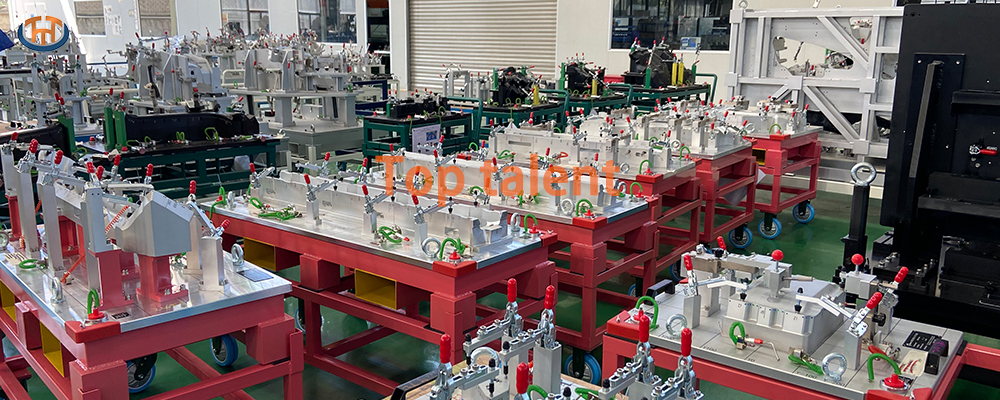
When a driver sits behind the wheel, their interaction with the vehicle begins at the dashboard. From the tactile feedback of buttons to the alignment of trim pieces, the quality of this interface defines the perception of the entire vehicle. However, achieving this level of fit and finish is impossible without a critical piece of manufacturing technology: the automotive dashboard part checking fixture.
In the world of production, components are not simply “made” and then assembled. They are verified. A checking fixture is a metrology device designed to hold a part in a specific orientation to verify its geometry, hole placement, and surface contours against the original Computer-Aided Design (CAD) model. For complex dashboard assemblies, these fixtures are the gatekeepers of quality.
The Complexity of Dashboard Assemblies
Modern dashboards are no longer simple plastic moldings. They are structural components housing airbags, infotainment screens, wiring harnesses, and ventilation ducts. A dashboard carrier—the underlying metal or plastic frame—must have every mounting point located within a fraction of a millimeter. If a threaded insert for the glove box latch is misaligned by just 2mm, it can lead to an assembly-line stoppage or a customer complaint about a “rattle.”
Automotive dashboard part checking fixtures address this by simulating the vehicle’s body-in-white (BIW) mounting points. By placing a production part into the fixture, quality technicians can quickly perform “go/no-go” checks to ensure that every critical interface—from the steering column support bracket to the defroster vents—meets specification.
Speed vs. Accuracy: The Manufacturing Balance
On a high-volume production line, time is money. Sending every dashboard to a Coordinate Measuring Machine (CMM) is accurate but slow. Checking fixtures offer a rapid alternative.
Modern fixtures utilize a combination of elements to balance speed with precision:
Hard Gauging: Pins and clamps that physically test if a hole is in the correct location.
Soft Contact Probes: Used for checking complex free-form surfaces where a simple pin won’t suffice.
Sliders and Rotational Mechanisms: These allow the operator to access undercuts or hidden features without damaging the part.
Adhering to GD&T Standards
The effectiveness of a fixture relies on strict adherence to Geometric Dimensioning and Tolerancing (GD&T). The fixture must replicate the vehicle’s datum structure. If the drawing specifies that a dashboard is located by three specific points (A1, B1, C1), the fixture must pick up the part at those exact locations. Failing to do so means the fixture might reject good parts or, worse, accept bad ones.
Future Trends: Automation and Data Integration
While traditional manual fixtures are still prevalent, the industry is shifting toward hybrid and automated solutions. Smart fixtures equipped with digital probes and sensors are now feeding real-time data back to Quality Management Systems. This shift from “pass/fail” detection to data-driven analysis allows manufacturers to spot tooling wear trends before they create defective parts.
Furthermore, as vehicle architectures become shared across multiple models, checking fixtures must be designed for flexibility. Modular fixtures that can be reconfigured for different dashboard variants (left-hand vs. right-hand drive) help manufacturers save on capital expenditure while maintaining rigorous quality standards.
In conclusion, the automotive dashboard part checking fixture may be hidden from the consumer’s eye, but its impact is felt every time a driver enjoys a quiet, rattle-free ride. It is a testament to the principle that in automotive manufacturing, precision is not just about aesthetics—it is about function, safety, and reliability.
Post time: Feb-27-2026

.png)
.png)