
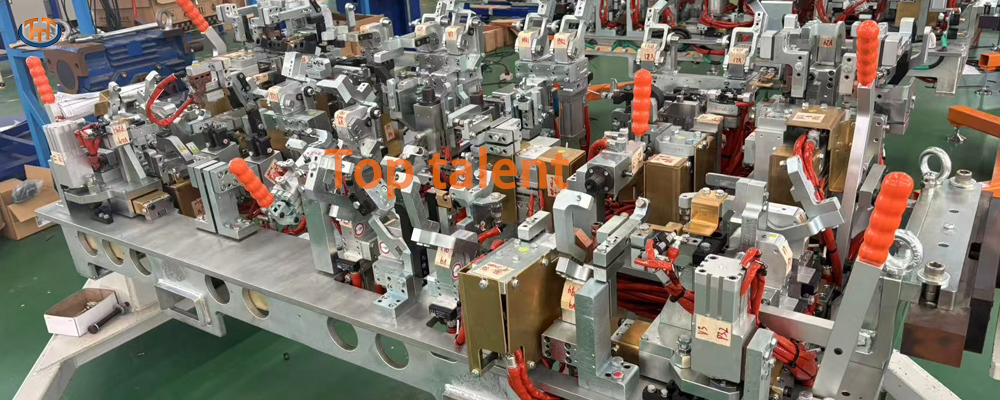
In high-volume automotive production, the spot welding fixture is the unsung hero of body assembly. While robots and welding guns capture the spotlight, these precision holding devices determine whether a vehicle meets safety standards or ends up as scrap metal.
What Is a Spot Welding Fixture?
A spot welding fixture is a custom-engineered clamping system that holds metal panels in exact position during resistance spot welding (RSW). Unlike general workholding tools, these fixtures are designed for a single vehicle model, positioning every door frame, roof panel, and structural component with micron-level accuracy.
Why Precision Matters
Modern unibody vehicles contain 3,000 to 5,000 spot welds. Each weld must land within a strict 2-3mm target zone. Without a rigid fixture, several problems emerge:
Weld expulsion – Poor fit-up causes molten metal ejection
Electrode wear – Misalignment accelerates tip degradation
Dimensional drift – Accumulated errors throw off subsequent assemblies
A quality fixture eliminates these variables. By constraining all six degrees of freedom, it ensures electrodes contact the exact spot every cycle.
Productivity and Throughput
Spot welding fixtures directly impact production speed. Key design features include:
Quick-change clamps – Reduce part loading to under 5 seconds
Integrated sensors – Verify correct positioning before welding
Ergonomic access – Allow multi-robot simultaneous operation
Modern automotive plants achieve 60-120 welds per minute per line. Without reliable fixturing, that pace becomes impossible.
Quality Assurance Impact
The fixture serves as a dimensional master. When paired with in-process monitoring, it detects:
Missing or double-thickness panels
Spring-back from forming operations
Thermal distortion during welding sequences
Manufacturers using precision fixtures report 40-60% fewer rework events compared to manual clamping methods.
Materials and Construction
Today’s fixtures balance rigidity with accessibility. Common materials include:
Cast aluminum – Lightweight for robotic handling fixtures
Hardened steel – High-wear locating pins and bushings
Polyurethane – Non-marring contact surfaces for finished panels
The Future of Fixturing
Industry 4.0 introduces smart fixtures with embedded load cells and wireless monitoring. These systems predict clamp wear and adjust positioning automatically. For electric vehicle production, fixtures now accommodate battery tray welding—where joint integrity affects thermal management and crash safety.
Bottom Line
The spot welding fixture transforms individual metal stampings into a cohesive body structure. While invisible in the final vehicle, its role in safety, dimensional accuracy, and production efficiency makes it indispensable. Automotive manufacturers investing in precision fixturing consistently achieve lower scrap rates, reduced downtime, and superior crash test performance.
Post time: Apr-10-2026

.png)
.png)