
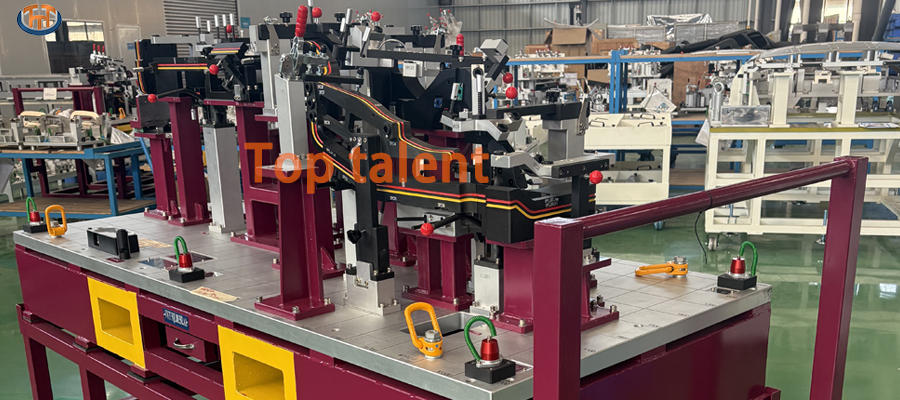
 In the fast-paced world of automotive manufacturing, precision is not just a goal—it is a requirement. Every curve, angle, and mounting point on a vehicle must adhere to strict design specifications to ensure safety, performance, and aesthetic appeal. One of the most geometrically complex areas of a vehicle body is the wheel housing. To ensure this critical zone meets exact standards, manufacturers rely on a specialized tool: the automotive wheel housing checking fixture.
What is a Wheel Housing Checking Fixture?
A wheel housing checking fixture is a custom-built, rigid measurement tool used to verify the dimensional accuracy of the wheel arch area on a car body-in-white (BIW) or on finished panels. Because the wheel housing accommodates the suspension, tire clearance, and often impacts the door openings, even a minor deviation can lead to assembly issues, tire rubbing, or poor fit-and-finish.
These fixtures are designed to replicate the nominal design of the wheel housing in a 3D space. By placing the component into the fixture, quality control technicians can quickly assess whether the manufactured part falls within the acceptable tolerance range.
Key Features of an Effective Fixture
Modern checking fixtures are engineering marvels in their own right. They typically consist of a sturdy aluminum or steel base plate, which provides a stable datum reference frame. Mounted to this base are various checking elements:
Profiles and Nets: These are cut-out sections that represent the true contour of the wheel housing. Technicians use them to visually inspect the gap and flushness of the panel.
Clamps: These secure the part in the exact position it would occupy on the vehicle.
Flush Pins and Indicators: These spring-loaded or manual devices measure specific points, such as bolt holes or edge contours, providing a go/no-go assessment of the part’s geometry.
Why Precision Matters
The importance of the automotive wheel housing checking fixture cannot be overstated. Firstly, it directly impacts vehicle safety by ensuring adequate clearance for the suspension travel and tire movement. Secondly, it contributes to the perceived quality of the vehicle; inconsistent wheel arch gaps can make a car look poorly assembled.
Furthermore, these fixtures play a vital role in lean manufacturing. By identifying geometric errors early in the production process—before the body moves to painting or final assembly—manufacturers avoid costly rework and scrap. In an era where electric vehicles (EVs) are introducing new chassis designs, the need for precise wheel housing validation has become even more critical to accommodate larger batteries and complex suspension systems.
The Future of Fixturing
As the automotive industry moves toward Industry 4.0, checking fixtures are becoming smarter. Modern wheel housing gauges are increasingly integrated with digital sensors and data acquisition systems. Instead of relying solely on manual visual checks, these fixtures can feed measurement data directly into statistical process control (SPC) software, allowing engineers to monitor trends and adjust manufacturing processes in real-time.
Conclusion
While often hidden from the consumer’s view, the automotive wheel housing checking fixture is an unsung hero of vehicle production. It ensures that every vehicle rolling off the assembly line has the structural integrity and visual precision demanded by today’s discerning drivers. For automotive engineers and quality managers, investing in high-precision checking fixtures is non-negotiable in the pursuit of manufacturing excellence.
Post time: Mar-13-2026

.png)
.png)