
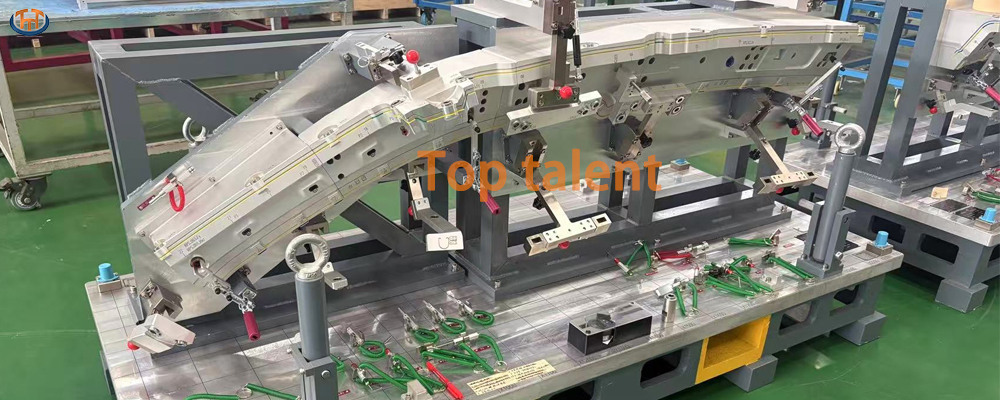
In the high-stakes world of automotive manufacturing, precision is non-negotiable. Modern vehicles are composed of thousands of components, with plastic parts accounting for a growing percentage of interior and exterior assemblies—from instrument panels and door trims to bumpers and lighting housings. Ensuring that these complex, often large-format plastic components conform to exact engineering specifications requires a tool that is as precise as it is durable: the Automotive Plastic Checking Fixture.
Also known as a “gauge” or “cubing,” a checking fixture is a custom-built quality control device designed to validate the dimensional accuracy of a plastic component. Unlike hand tools such as calipers or micrometers, which measure discrete points, a checking fixture provides a comprehensive, go/no-go assessment of the entire part geometry.
The Anatomy of Precision
A typical checking fixture consists of a rigid base—often constructed from aluminum or high-density polyurethane (HDU)—onto which the plastic part is mounted. The fixture incorporates several key elements:
Locators: Precisely machined pins and pads that mimic the vehicle’s assembly points, ensuring the part is seated in the same orientation as it will be in the final vehicle.
Clamps: Pneumatic or manual clamping devices that hold the part securely without inducing deformation.
Inspection Elements: These include flush pins, gap gauges, and spring-loaded indicators that allow operators to measure critical contours and mating surfaces against the Computer-Aided Design (CAD) nominal data.
Why Plastic Requires Specialized Fixturing
Plastic automotive components present unique challenges. Due to their material properties, they are susceptible to warpage, sink marks, and thermal expansion. A checking fixture is engineered to simulate the “free state” or “restrained state” of the component as dictated by the GD&T (Geometric Dimensioning and Tolerancing) standard.
For instance, a large fascia (bumper cover) must be checked to ensure that the gaps to the headlamps and hood are consistent. A tolerance deviation of just 1 millimeter can lead to wind noise, water leaks, or a misalignment that is visually unacceptable to the end consumer. The checking fixture allows manufacturers to detect these micro-deviations before the part ever reaches the assembly line.
Benefits Beyond Measurement
Investing in high-quality checking fixtures yields significant operational returns:
Speed: Visual and tactile inspection on a fixture is exponentially faster than Coordinate Measuring Machine (CMM) scanning for 100% inspection.
Repeatability: It eliminates human error associated with hand tools, ensuring that a part checked in Mexico meets the same standard as a part checked in Germany.
Root Cause Analysis: When a part fails a fixture check, the fixture itself serves as a diagnostic tool. Engineers can immediately identify whether the fault lies in a specific cavity of a mold or in the post-molding cooling process.
The Future of Fixturing
As the automotive industry shifts toward electric vehicles (EVs) and autonomous driving, the demand for aerodynamic, lightweight plastic components is skyrocketing. Consequently, the checking fixture industry is evolving. We are seeing a rise in modular fixtures equipped with digital sensors and laser scanners that feed data directly into statistical process control (SPC) software.
In conclusion, the automotive plastic checking fixture is far more than a holding device. It is the final gatekeeper of quality, bridging the gap between injection molding and vehicle assembly. For manufacturers aiming to reduce scrap rates, accelerate time-to-market, and protect brand reputation, the precision engineering of the checking fixture remains an indispensable investment.
Post time: Mar-28-2026

.png)
.png)